Before we talk about markets, we have to ruin one of the biggest lies in finance.
Markets were never built for traders. Traders found a system that already existed, one built by people who needed something entirely different, and then spent a century convincing themselves it belonged to them. Almost everything retail believes about price follows from that misunderstanding, and very little of it survives contact with the machinery underneath.
So start there.
The rest of this briefing is for readers on the list.
Free, permanently. Enter your email and a link comes back that unlocks every piece on the site, current and future.
Part I: Markets were never built for traders
Every business has one thing it cannot engineer away: uncertainty.
A farmer does not know what corn will bring in October. An airline does not know what fuel will cost next quarter. A pension fund does not know where equities will trade when its obligations come due. Each can improve its estimates, build models, and prepare for several outcomes, but none can remove the fact that tomorrow arrives after today's decisions have already been made.
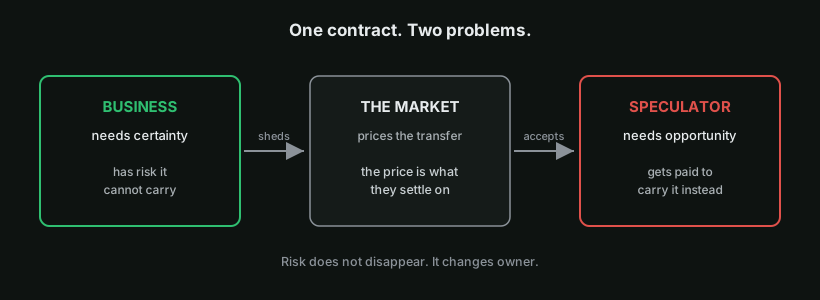
Markets existed long before the modern trader because businesses needed somewhere to transfer part of that uncertainty. The farmer sells a contract and places a floor beneath future revenue. The airline buys one and turns an unstable input into something closer to a known expense. Neither has predicted the future, and neither needs to. They are not trading to be right. They are trading so that being wrong does less damage.
That kills the founding myth. Futures were not created to give speculators somewhere to express an opinion. Speculators arrived because someone else needed insurance, and insurance only works when another participant is paid to carry the uncertainty being removed. The speculator is not the reason the market exists, but the speculator is one of the reasons it functions.
Part II: Same trade, opposite purpose
Pause here, because this is the part that rearranges everything.
An airline and a hedge fund can both buy crude futures. Same contract, same price, same second, same exchange, and possibly the same counterparty. On the chart, the transactions are indistinguishable. Economically, they may have almost nothing in common.
The airline may be reducing the risk that higher fuel prices damage its margins. The hedge fund may be accepting that risk because it expects crude to rise. One is buying certainty. The other is buying exposure.
This split is what makes a market possible. On one side are participants using contracts as operating tools, where a futures position is a business decision wearing market clothes. On the other are participants willing to carry the exposure because they believe the price compensates them for doing so. Neither side is automatically smarter, and neither side needs to share the same reason for making the trade.
That is why "smart money" is usually the wrong phrase. Commercial participants do not necessarily have a better forecast. They are simply closer to the activity beneath the contract. They sit inside the harvest, the refinery, the loan book, or the supply chain itself, where changes in inventory and demand appear before they become a clean line on a chart.
The edge is not foresight. It is proximity, and proximity changes the problem being solved.
A business may keep buying as price falls, not because it has called the bottom, but because each lower price improves the economics of something it already needs. A systematic trend fund may keep selling through the same decline because persistence is exactly what its mandate is built to capture. One participant is improving the terms of its operation while the other is following the direction of price. The trades can oppose each other without either participant behaving irrationally.
Commercials are not trying to win an argument with the market. They are trying to keep the market from winning an argument with their business.
The professional question is therefore not simply who is buying. It is what problem the contract solves. Corn futures manage uncertainty around harvest revenue. Crude futures manage revenue risk for producers and input costs for consumers. Treasury futures allow banks to adjust duration without rebuilding an entire loan book. Equity index futures give institutions somewhere to reduce broad exposure without selling hundreds of individual positions through a nervous afternoon.
Once you understand the business problem, positioning stops looking random and starts looking like accounting.
One discipline holds the method together. The data shows behavior, never intent. It tells us that exposure changed, but it does not tell us what a participant believed while changing it. The moment an interpretation claims to know the motive, it has left the evidence and started writing fiction with a terminal open.
You can reason from the economics of the business.
Part III: The market talks back
The businesses inside markets are not fixed characters performing the same role forever. They are open systems, continually adjusting as prices, costs, demand, financing conditions, and expectations change.
A farmer's hedge changes when weather alters the expected harvest. An airline adjusts its fuel exposure when routes, passenger demand, margins, or the forward curve offer a different set of terms. A bank changes its duration when deposits move, loan demand changes, or interest rates begin affecting the balance sheet in a new way.
The market does not merely record those decisions. It helps create the conditions that produce the next ones.
Higher oil prices can encourage production, reduce consumption, change hedging activity, redirect capital, and alter the economics of entire industries. Those responses then become new information for the same market that produced the higher price in the first place. Fundamentals shape price, price changes incentives, incentives alter behavior, and behavior changes the fundamentals.
That is the open feedback loop.
It is also why a positioning category can remain the same while the meaning of its exposure changes. The same producer may hedge more aggressively when margins are attractive, reduce protection when inventory falls, or shift the timing of its contracts when financing becomes expensive. The label remains commercial. The business problem underneath it keeps moving.
Yesterday's position solved yesterday's conditions. Today's information creates a different problem, and tomorrow's position may look different because of it.
Price, then, is not a scoreboard sitting outside the economy. It is part of the economy's adjustment process. It changes production, consumption, financing, inventory, and risk-taking, and those decisions return to the market as the next round of supply and demand.
The market observes the economy while the economy responds to the market. Neither ever reaches a final answer.
Part IV: There is no algorithm
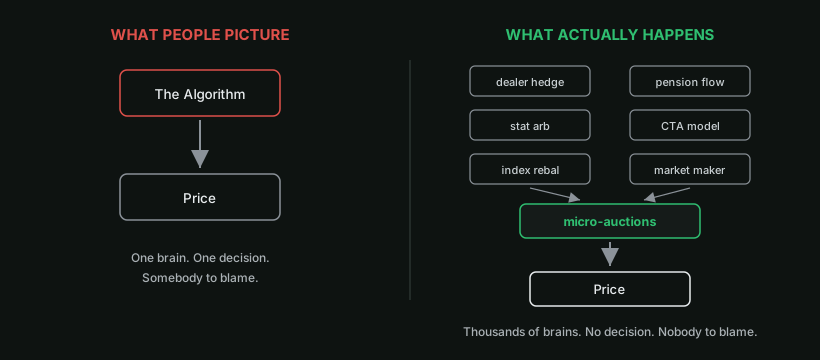
Retail has a favorite ghost: the algorithm, singular and definite. It hunts stops, knows where you are, and apparently has cleared its schedule to deal with your four-lot position.
There is no algorithm. There are thousands of systems responding to thousands of different problems.
Freeze the market for one second and you will find dealers hedging options, pension funds reallocating, index funds tracking benchmarks, market makers managing inventory, and CTAs following trend. Some are responding to price. Others are responding to volatility, correlations, client activity, financing costs, or changes elsewhere in their portfolios.
None of them need to understand the whole market, and none of them are thinking about your chart. Together, their separate adjustments create what we call price.
Price is not generated by a single hand. It emerges from competing needs, each feeding information back into the next decision.
Part V: Every negotiation ends two ways
Here is the next thing to throw out: price does not rise because buyers outnumber sellers.
Every contract traded has one buyer and one seller. The counts are always equal. What changes is how urgently one side needs to transact and how far price must travel before another participant is willing to take the other end.
Price is where the negotiation clears.
Value, in this sense, is not an opinion about what something should be worth. It is a range where enough participants are willing to continue doing business. That is why price can remain inside the same area for hours without producing meaningful movement. The auction is finding agreement, and as long as that agreement holds, there is no reason for price to search elsewhere.
When price leaves the range, the auction is looking for a new area where business can continue. That search is what most people call a trend, although the word makes the process sound more organized than it usually is.
Every negotiation ends one of two ways. We continue doing business, or somebody walks away. Markets call those outcomes acceptance and rejection.
When trade continues at a new level, that level is being accepted and value can begin moving toward it. When participation disappears, the auction has failed to facilitate business there. Nobody has been proven wrong in some grand philosophical sense. The supply of willing participants has simply run out.
Rejection is the useful part. When aggressive selling arrives and price refuses to move lower, sellers are applying pressure without receiving forward progress. Someone else is willing to absorb what they are offering, and each failed attempt becomes information for both sides.
Sellers who are rewarded may press harder. Sellers who repeatedly fail may reduce risk, leave, or reverse. The absorbing side is also learning. If it continues to hold price in place, it may become more willing to accept inventory. If it begins to struggle, its withdrawal can release the pressure that had been contained.
The auction has its own feedback loop.
Think of it like a rubber band. Aggressors keep pressing into a range while another balance sheet absorbs the pressure and holds the auction together. The tension builds quietly through repeated attempts, inventory transfers, and failed extensions. Eventually the absorbing side finishes or the aggressor gives up, and price moves as the balance between them changes.
This is why time spent inside a consolidation matters. A range held for an hour contains an hour of negotiation, adjustment, and inventory transfer. A range held for a week contains a week of it. The stretch and the snap are not separate events. They are the same process viewed at different moments.
Part VI: Ownership moves before price
Now the idea the whole series rests on.
Every contract moves from one balance sheet to another, from participants seeking certainty toward participants willing to carry uncertainty, and back again when the terms change. Price records where that transfer happened, but the transfer itself often begins before price makes the result obvious.
Which reframes the cycle entirely. It is not a shape on a chart. It is a migration.
Inventory rarely changes hands where everyone notices. Patient balance sheets accumulate while price appears quiet. Markup is often price catching up to a transfer that has already occurred. Distribution is the same process in reverse, as inventory moves from participants willing to hold it toward those arriving later.
Eventually, everyone willing to own the inventory under the current conditions already owns it. The auction struggles to facilitate additional trade, price moves, and the new price changes the incentives of everyone involved. Some holders take profit. Some producers increase output. Some consumers reduce demand. Others discover that what looked attractive yesterday no longer works at today's terms.
Ownership changes price, and price changes the willingness to own.
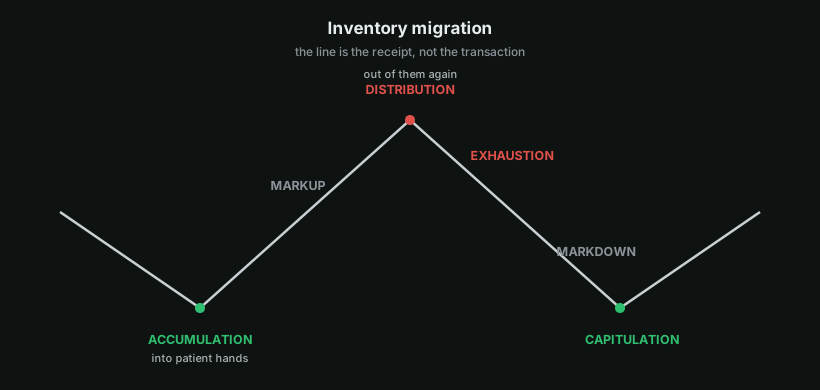
The price is often the last thing to change hands. Ownership moves first.
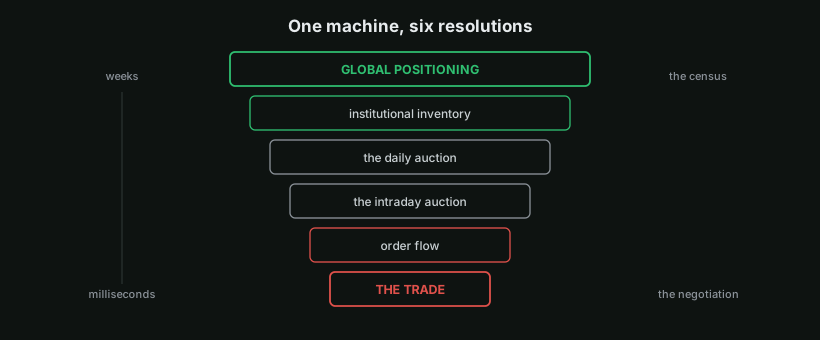
So how does a weekly census of positioning connect to what price does at 10:42 tomorrow morning? It does not, at least not directly. The missing piece is scale.
Positioning sits at the top, showing how inventory is distributed over weeks. Underneath it are the institutions carrying that exposure, then the daily auction, the intraday auction, order flow, and finally the individual trade.
Every layer is the same machine measured on a different clock. Zoom out and it is a census. Zoom in and it is two systems disagreeing over a tick.
The connection also runs in both directions. Higher-timeframe inventory creates pressure that may eventually appear in the daily auction. What happens inside that auction then affects how institutions manage the inventory. A failed breakout, a change in liquidity, or an unexpected response to new information can cause exposure to be added, reduced, or transferred.
Positioning informs the auction, and the auction updates the position.
Large positions cannot appear or disappear all at once. Institutions need enough liquidity to absorb their size, which is why higher-timeframe inventory often reveals itself around areas where the market repeatedly conducts business. The positioning report does not tell you where price trades tomorrow. It tells you how inventory is arranged and which side may be carrying more pressure. The auction tells you whether that arrangement continues to be rewarded or has started to change.
Positioning creates pressure. Liquidity determines where ownership can transfer. The auction determines whether the existing position can survive the next piece of information.
Part VII: Every price is already history
None of this is unique to finance.
Swap corn for copper. Replace the airline with a trucking company. Exchange futures for houses, shipping containers, or electricity. Somewhere, someone is carrying inventory they would rather transfer, and somewhere else, someone is willing to carry it at a price both can accept.
But the agreement is already history by the time you see it. A trade prints, and by the time it reaches the screen, it has happened. The number on the chart is the latest entry in a ledger of agreements already completed, each one true for exactly the instant it was struck.
Markets do not produce permanent answers. They produce temporary agreements, and price is the number history remembers until it writes down another one.
Before that happens, the current price has already changed behavior. It has altered the economics of the producer, the urgency of the consumer, the exposure of the institution, and the opportunity available to the speculator. The receipt becomes information for the next transaction.
Start underneath
Markets do not exist to predict tomorrow. They exist to reconcile uncertainty today, then adjust when tomorrow arrives differently than expected.
Every chart is the visible record of negotiations between balance sheets solving different problems. It is not a forecast. It is a receipt printed after the transfer cleared, which then becomes part of the information shaping the next decision.
So who makes the price? No one participant does, but every participant contributes.
Businesses transfer risk, speculators accept it, institutions execute it, and thousands of competing systems facilitate it. None need to coordinate, and none need to understand the whole. The auction reconciles their decisions, price records the agreement, and the agreement changes what everyone does next.
The next time you open a positioning report, do not begin by asking where price is going. Ask who needs the market, what uncertainty they are transferring, and who is being paid to carry it. Then ask whether the auction continues to reward that arrangement or has begun forcing it to change.
Price is the receipt. Ownership is the transaction. The feedback loop is what keeps the market alive.
That is all for this one. I will see you in the next.