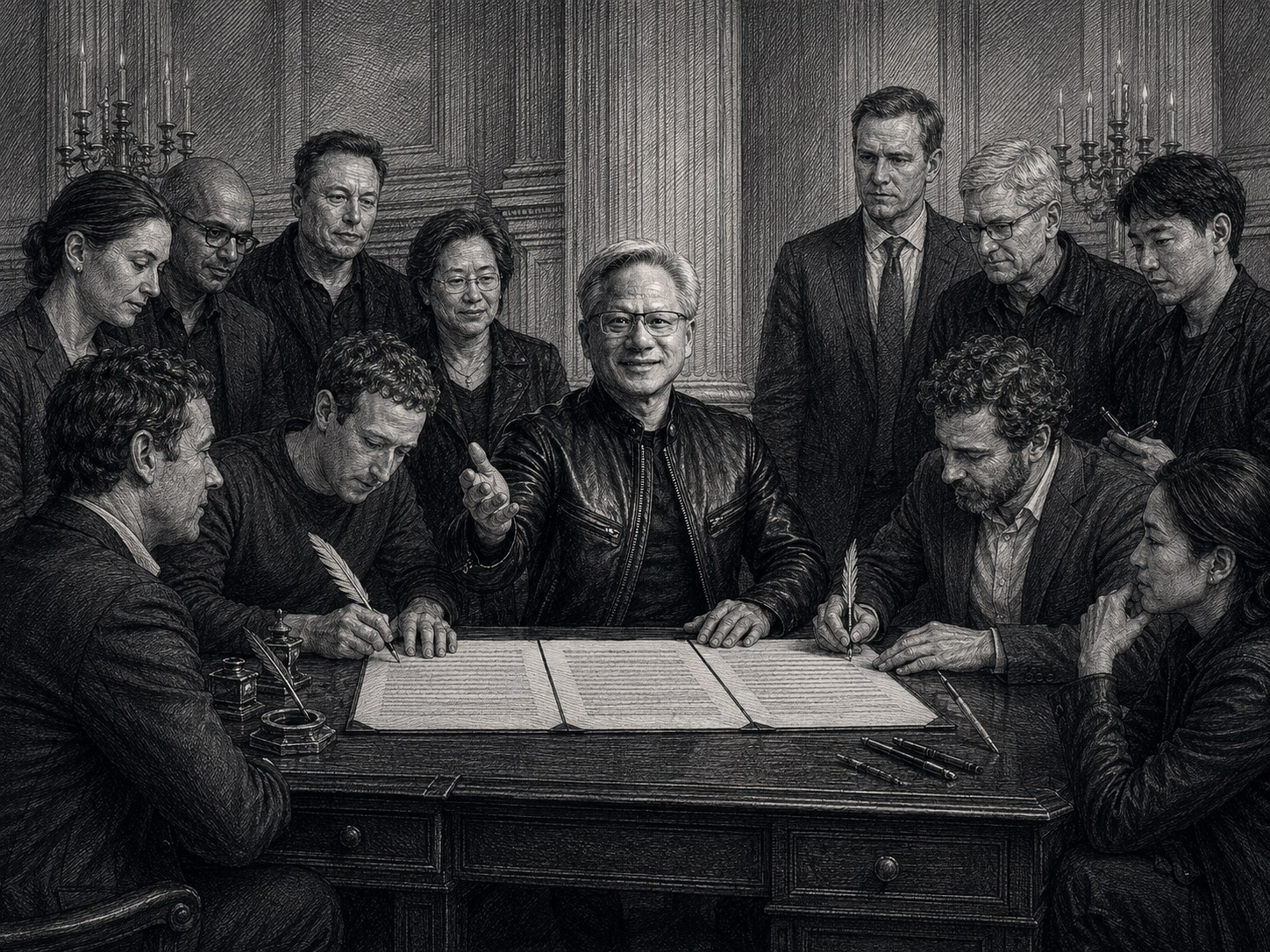
Jensen Huang joined X in June and posted nothing for a month. When he finally posted on July 24, it was not about a new chip, a product roadmap, or the latest argument over artificial intelligence. It was a three-page letter titled Open Weights and American AI Leadership, signed by NVIDIA and twenty-four other companies, asking Washington not to place early restrictions on models that anyone can download and run.
Huang has never lacked places to discuss AI. He has keynotes, earnings calls, and an interview schedule with no obvious end. Two days earlier, he had praised Chinese open models and argued that American companies should be free to use them. But his first post in the one place where he speaks only for himself was about how the law should treat downloadable model weights.
On its own, that is an interesting choice. It matters more as a sign of something that happens to most important industries eventually: the central argument changes before most people notice that the source of value has changed with it.
The rest of this briefing is for readers on the list.
Free, permanently. Enter your email and a link comes back that unlocks every piece on the site, current and future.
Part I: What an industry argues about
Every industry has one constraint that matters more than the others. It is the thing that is hardest to obtain, the thing that earns the highest return, and usually the thing everyone spends the most time fighting over.
That gives us a useful way to study an industry. Pay attention to what it argues about, because the argument often reveals what the industry believes is becoming scarce.
The debate usually moves through three questions. First, does the technology work? Then, can it scale? Finally, who is allowed to use, sell, or distribute it?
Aviation, pharmaceuticals, and telecommunications all followed some version of that path. Their technical problems never disappeared. What changed was which problem carried the greatest economic value.
The move from one question to the next leaves a trail. Language usually changes first because words can move before a company is ready to admit that its economics have changed. Capital moves next because money has no reason to wait for the public story. Policy arrives last and makes the most noise, because law becomes valuable when engineering alone can no longer protect a position.
Speed offers another clue. The open-weights letter launched with twenty-five names, reached thirty-two by that evening, and passed fifty within two days. Industries do not organize that quickly around something they consider secondary. The argument had already been forming before the letter appeared.
A policy letter is often what an industry produces when a benchmark can no longer settle the question.
Part II: The tell in the language
The letter makes several arguments. Open weights allow startups, universities, and public institutions to build useful systems without training a frontier model from the beginning. Keeping advanced AI inside a small number of closed platforms creates concentration risk. A closed model can fail or be compromised without outsiders being able to inspect it. Distillation can be a legitimate way to build better models, and policymakers should pursue theft directly rather than restricting open weights to reach it.
The letter also argues that American leadership will not be decided by one company producing the best model. It will be decided by whether AI spreads into factories, hospitals, farms, classrooms, and smaller businesses. To help that happen, the signatories ask for wider access to computing power and public funding for shared training resources.
Now consider what the letter does not discuss.
There is almost nothing about artificial general intelligence, superintelligence, scaling laws, reasoning breakthroughs, or capability thresholds. Three pages about the future of AI contain no benchmark and almost no technical measurement.
That omission matters because of who signed it. NVIDIA spent years explaining that greater capability requires more computing power. Meta includes performance tables with its model releases. Mistral and Black Forest Labs built much of their public case around the quality of their models.
These companies know how to make an argument with numbers. They chose not to.
In place of benchmarks, the letter uses words such as access, diffusion, ecosystems, sovereignty, prosperity, national security, and the application layer. These are not engineering terms. They are the language of distribution and policy.
The change does not require us to guess at anyone's private motive. The companies are making a public case for keeping a resource widely available. Businesses rarely fight to keep something abundant when their advantage still depends on keeping it scarce.
Huang's own comments support that reading. Earlier in the year, he said that one in every four generated tokens came from an open model. In July, he praised Moonshot's Kimi K3, which publishes its full weights shortly after release. Once those weights are public, even the company that created them cannot pull every copy back.
A benchmark still measures capability. It simply stops proving that one company owns a lasting advantage once several competitors can post a similar score.
Part III: The tell in the money
The next step is to ignore what the companies say and look at how they earn money.
The original signatories came from nearly every part of the AI stack. They sold chips, servers, cloud capacity, software, attention, open-model tools, venture capital, and even the physical materials needed to support the buildout.
One business model was largely missing. None of the original signatories earned most of its revenue by selling access to a closed frontier model.
That does not mean every company with similar economics signed. CoreWeave rents GPUs and stayed off the first list even though NVIDIA is an investor. Other cloud and data companies also remained absent despite benefiting when models become cheaper and more widely used.
The explanation may be simpler than disagreement. If the coalition succeeds, the policy applies across the industry. A company can benefit from the outcome without paying the cost of attaching its name to the letter. Sometimes sitting out does not reveal opposition. It reveals confidence that others will do the lobbying for you.
The broader point remains. Companies generally do not sign public letters asking for their own main product to become easier to copy and cheaper to access.
Microsoft is the most revealing name on the original list. It is OpenAI's largest investor and primary computing partner, yet Microsoft signed before OpenAI did. Days earlier, GitHub Copilot had added a Chinese open-weight model.
That does not mean the companies had become opponents. It means their economics were beginning to point in different directions. Microsoft increasingly earns money from infrastructure, software, and distribution. OpenAI's value remains more closely tied to the intellectual property inside its models.
Shared ownership does not guarantee shared incentives.
NVIDIA's support is also easier to understand through economics than preference. A small group of hyperscalers buying enormous amounts of computing power can negotiate together, build their own chips, and place pressure on NVIDIA's margins. Thousands of smaller companies running their own models do not have the same power.
Open weights help spread AI beyond a few large buyers. That makes them useful to NVIDIA, but the goal is not openness for its own sake. The goal is wider demand and less customer concentration. If another method produced that result more effectively, the incentive would move with it.
This is why the letter keeps returning to factories, hospitals, farms, classrooms, and smaller businesses. These are not model companies, and most will never train a frontier system. They are future users of chips, cloud infrastructure, software, and inference.
By the time the letter was published, capital had already begun moving away from the model as the only place where value could be captured.
Part IV: What a signature costs
The list changed quickly. It began with twenty-five names, reached thirty-two by that evening, and passed fifty by Sunday. OpenAI joined roughly eleven hours after being absent from the launch. Google and AMD followed later.
The easy conclusion is that an industry consensus formed over the weekend. That assumes every company faced the same cost for signing, which they did not.
On the first morning, a GPU company could sign while defending its existing business. A company selling access to a closed model faced a harder choice because the letter could weaken the scarcity supporting its pricing. The early list was useful because the cost of signing was uneven.
By that evening, the cost had changed. Media coverage began naming the companies that had stayed away. Absence was no longer neutral. It started to look like support for restricting downloadable models.
Nothing about OpenAI's business changed between breakfast and dinner. The reputational cost of not signing did.
Once that happened, the list became less useful as evidence of industry structure. Early names revealed where the economics pointed. Later names increasingly revealed that public silence had become expensive.
The coverage was no longer only describing the coalition. It was helping expand it.
This is true of most public rosters. Their analytical value declines once the roster itself becomes the story. An analyst prefers a shorter list because the dividing line is clearer. A policymaker prefers a longer list because the number of names becomes part of the argument.
Fifty signatures made the coalition less useful as a map of incentives and more useful as a lobbying document. That exchange took about forty-eight hours.
Amazon, Anthropic, and xAI remained outside the group. Their absence was not equally costly because each had already built some part of its public identity around caution or a different view of risk. They were also preserving the argument that the letter moves past too quickly: once model weights are released, the release cannot be undone.
The letter acknowledges that problem but answers it mainly through competition and national leadership. The holdouts are keeping the risk side of the argument alive.
The story, then, is not really about who signed. Coalitions form around whatever an industry believes is about to be decided. This one formed around who gets to distribute intelligence.
Part V: Where scarcity goes
The letter compares open-weight AI with the open-source software movement of the 1980s. It argues that early restrictions could have prevented much of the modern internet from developing.
That comparison is flattering, but it is not the most useful one. Electricity provides a better example because it shows what happens when an important input becomes cheap and widely available.
Scarcity did not disappear when electricity spread. It moved.
Factories that replaced steam engines with electric motors but kept the same floor plans gained less than expected. They had purchased a faster version of the old system. The larger gains went to companies that rebuilt the factory around distributed power, changing the placement of machines, the flow of work, and the design of the operation itself.
The delay between cheap electricity and higher productivity was not mainly a supply problem. It was an organizational one.
That is the lesson worth carrying into AI. When an input becomes abundant, the ability to reorganize around it becomes scarce.
Adoption and reorganization are not the same thing. An accounting firm adopts AI when it closes the books in three days instead of five. It reorganizes when it changes a business model built around billing for human hours.
Most companies will do the first and describe it as the second. The obstacle is rarely access to the tool. Reorganization requires leaders to admit that the current structure was built around a limitation that may no longer exist. That decision must often be approved by the same people whose authority and compensation came from the old structure.
This is why cheaper intelligence may not lift every company equally. It may widen the distance between the best operators and the average ones. Electrification did not make every manufacturer more productive at the same speed. It created a larger gap between the companies that redesigned their operations and those that simply installed new equipment.
The useful question is not which companies will adopt AI. Almost all of them will. The useful question is why two competitors with the same tools and similar budgets may end up several years apart.
The letter partly admits this without saying it directly. Two of its main requests ask the government to reduce the cost of an input by expanding access to compute and funding shared training resources. Industries do not usually ask the state to make an input cheaper while that input remains the main source of their pricing power.
The value may therefore move toward the users, but only toward the minority capable of changing how their businesses work. Factories, hospitals, farms, and classrooms appear throughout the letter, yet none are represented among the signatories. They are also difficult to value in advance because there is no clean measure for organizational competence.
Two developments could prove this reading wrong. The first is that AI may not spread as widely as the coalition expects. Some industries remain concentrated even after the technology matures. Commercial aviation, for example, settled into a duopoly.
The second is that scarcity could return to the model itself. A new architecture may appear that cannot be copied from its outputs, or the cost of building the next generation may rise beyond what all but a few firms can afford.
The letter tells us where the industry believes it stands. It does not prove that the industry is correct.
Part VI: The argument nobody was having
For three years, the hardest question in artificial intelligence was whether anyone could build systems this capable. Nobody needed to write to Washington about that problem because the answer was going to come from engineering.
Now dozens of companies are organizing around a different question. They are not saying that technical progress has ended, or that models no longer matter. They are signaling that they do not expect the next durable advantage to be won in exactly the same place as the last one.
The remaining holdouts matter because their disagreement gives the coalition meaning. Without a credible opposing view, fifty signatures would say little more than fifty companies found the same public position convenient.
The industry has started making its case through policy, access, and distribution rather than benchmark tables. That change in subject is the evidence.
An industry tells you what it believes is scarce by what it argues about.