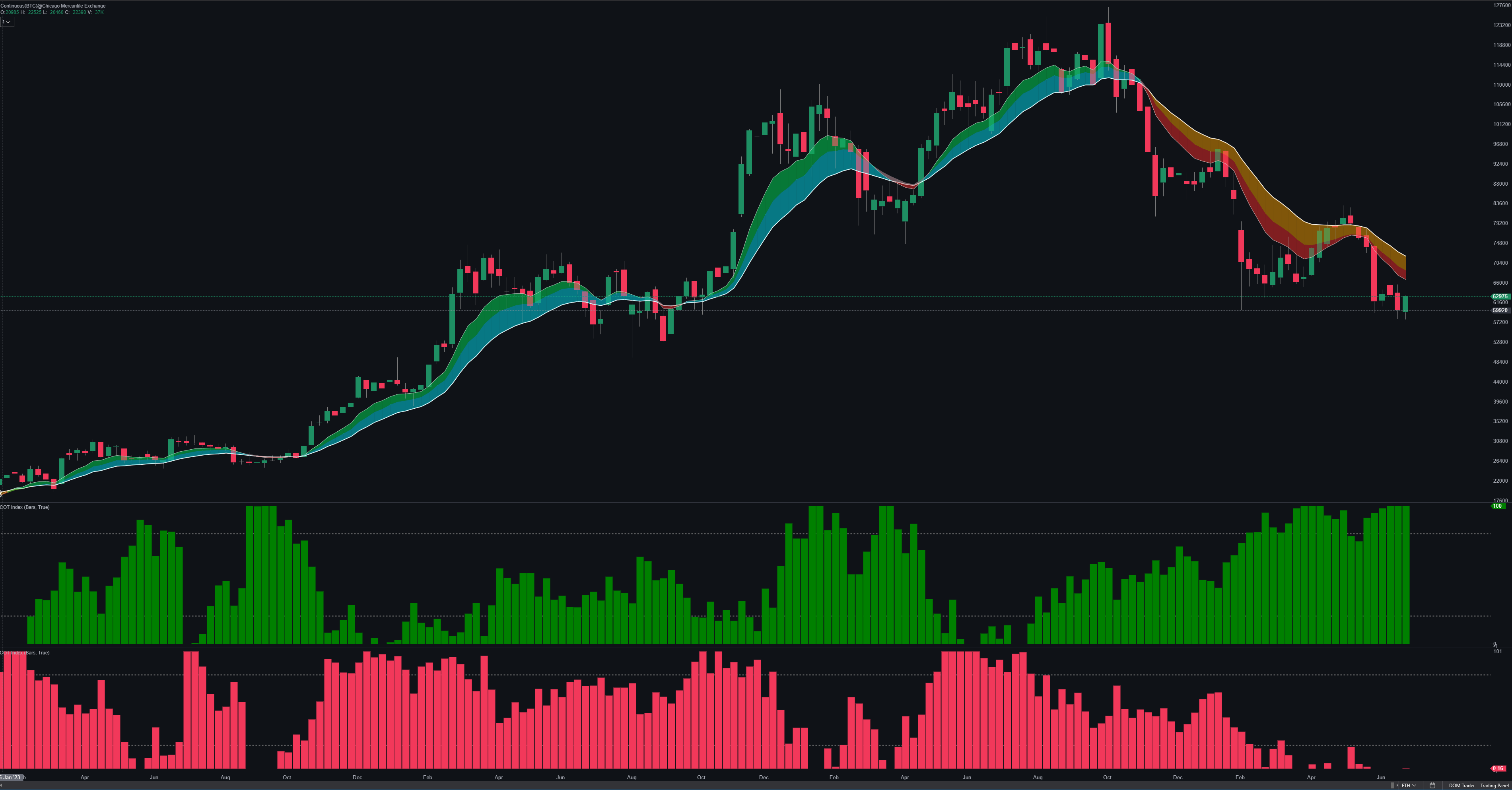
June produced the largest monthly outflow on record from spot Bitcoin funds, with roughly $4.5 billion leaving on a net basis. During the same period, managed money in the futures market appeared more bullish than at any other point in the available positioning history.
Those facts seem to describe opposite markets. One group is leaving while another appears to be pressing harder in the other direction, yet price continues to fall.
The contradiction does not necessarily tell us that one side is early and the other is wrong. It may tell us that the positioning label hides more than one kind of trade, while the failure of speculative buying to lift price still creates risk for the portion that is directional.
Neither side has earned the trade yet.
The rest of this briefing is for readers on the list.
Free, permanently. Enter your email and a link comes back that unlocks every piece on the site, current and future.
Part I: The contradiction that may not exist
Net fund flows for the year now stand at roughly negative $5.2 billion. The latest stretch has included ten consecutive sessions of withdrawals, removing another $2.73 billion while Bitcoin fell below $58,000, its lowest price in twenty-one months. A major bank also lowered its twelve-month target for the second time this year after removing future fund inflows from its model.
Against that backdrop, futures positioning looks strangely optimistic. Managed money exposure sits at the most bullish end of its historical range, commercial exposure remains near the opposite extreme, and Ether shows a similar divide. Open interest, meanwhile, remains relatively low.
One explanation is that futures traders are trapped. They built long exposure while the main source of spot demand weakened, leaving them vulnerable to another decline. Another is more constructive: futures participants are accumulating what fund holders are discarding and may benefit once redemptions end.
Both interpretations assume that a futures long represents a bullish opinion.
That is where the reading becomes less reliable.
Part II: A bookmaker is not a fan
A bookmaker carrying a large position on the favorite is not necessarily cheering for the favorite. He may simply be balancing what sits on the other side of the book.
The same distinction matters in Bitcoin futures. A participant can buy futures while selling or redeeming an equivalent amount of spot exposure. The gain on one side offsets the loss on the other, leaving the participant concerned less with direction than with the spread between the two prices.
What appears in the report is a large futures long. What exists economically may be a trade designed to collect carry.
This likely explains part of the disagreement between fund flows and futures positioning. Spot exposure can be reduced while futures exposure increases because the transactions belong to the same structure rather than opposing views.
The label says bullish. The position may only be balanced.
That is the broader limitation of positioning reports. Their categories describe what kind of entity filed the position, not what that entity is trying to accomplish. The report cannot tell us whether a managed-money long is an outright bet, one side of a hedge, or part of a trade spread across several venues.
Bitcoin makes this distinction especially important. The same participant can hold spot, futures, fund shares, options, and related exposure across several markets. The report captures one part of that structure and leaves the rest outside the frame.
We cannot determine how much of the position is directional and how much is hedged. But we can still study what price does while the reported buying is taking place.
Part III: Pressure without progress
Across most markets, one principle survives differences in asset class and participant type. When one side applies visible pressure and price refuses to move in that direction, the failure matters.
Buying is supposed to lift price. When sustained buying fails to do so, the participants responsible are not being rewarded for the risk they are carrying.
Some of the exposure may be hedged, and some participants may be able to tolerate more pain than the market expects. But any genuinely directional longs inside the managed-money category become more vulnerable with each failed attempt to produce forward progress.
They entered to profit, not to become permanent custodians of a losing position.
Once a trade stops paying, the question changes from how much more participants are willing to buy to how long they are willing to remain. If enough begin reducing risk together, their exits can become the next source of pressure.
Just as price can rise quickly when sellers capitulate and buyers flood the bid, it can fall quickly when disappointed longs begin offering into a market already struggling to absorb supply.
This is the part of the positioning signal that still matters. We may not know how much of the reported long is directional, but the portion that is directional is failing to produce the outcome it was built to capture.
Pressure is present. Progress is not.
That creates liquidation risk. It does not, by itself, create a short.
Part IV: Reduce the signal, do not reverse it
When a positioning read stops making sense, the temptation is to invert it. If heavy managed-money exposure cannot be treated as bullish, the more sophisticated conclusion seems to be that the longs are trapped and therefore bearish.
The classification problem does not disappear because the conclusion has been reversed. We still cannot tell how much of the position belongs to directional buyers and how much belongs to hedged structures that are largely indifferent to price.
The better response is to reduce the signal's authority.
Positioning tells us that substantial futures exposure exists on the long side. Price tells us that the exposure has not produced meaningful progress. Together, those facts identify vulnerability among the participants who are genuinely directional, but they do not tell us how large that group is.
The signal is not useless.
It is incomplete.
Part V: What remains dominant
Fund flows remain the clearest short-term mechanism in Bitcoin. Sell-side research has estimated that they explain roughly 45 percent of weekly price movement, and June provided a direct example. Fund holders redeemed, the underlying exposure had to be reduced, and the selling continued as long as the withdrawals continued.
The process is partly mechanical. When money leaves the funds, the structure creates supply. When the withdrawals stop, that source of supply begins to change without anyone needing to become more optimistic.
This is why failed futures buying cannot be treated as a complete bearish signal. Spot flows carry more volume and provide more direct information about the pressure currently shaping price. As long as withdrawals continue, futures buyers are trying to absorb the stronger force.
They are currently losing that contest.
But the same evidence does not justify becoming blindly bearish. Open interest remains relatively subdued, and the decline has not been accompanied by a large expansion of newly created short exposure. There is clear selling pressure, but no clean measure of how much additional pressure remains.
The condition to watch is simple. The outflows need to stop.
They do not need to reverse immediately or attract billions in fresh demand. The market first needs a break in the repeated withdrawals supplying the decline.
That break has not happened. One positive daily flow would still be a single observation against the billions that have left this year. Building a constructive case before the selling mechanism changes would turn an observable condition into a forecast.
The Federal Reserve meeting at the end of July is the next obvious event because it can affect the dollar, funding conditions, and the willingness to hold risk at the same time. Its importance will come from whether it changes the flow pattern and how price responds if that pressure begins to ease.
What we can say is narrow. Bitcoin has a dominant flow mechanism that remains negative. It also has visible futures buying that has failed to lift price, leaving any directional longs vulnerable if the decline continues.
One condition argues against being long. The uncertainty inside the other argues against being blindly short.
Diverging signals are not always a puzzle that needs to be solved immediately. Sometimes they are the clearest reason not to act yet.
A bookmaker is not a fan. A struggling buyer is not harmless. Neither is enough, on its own, to justify the trade.