
Part 1: The only two prices that matter
Every quarter arrives with hundreds of economic releases, dozens of markets worth an opinion, and an endless supply of explanations for why prices moved yesterday. Most of them matter less than they appear to. Usually only one or two prices actually resolve the board. Everything else spends the quarter reacting to information those prices have already finished processing.
This quarter, those prices are the dollar and the 30-year Treasury.
The equity market spent Q2 asking whether it could keep climbing, and it answered yes, loudly. The S&P finished up fourteen percent, the Nasdaq 100 up twenty-five, the best quarter in five years. That answer was real. It was also an answer to a question nobody important was asking. Underneath the rally, the price of dollars and the price of long-duration money were being repriced by forces the rally never acknowledged, and those two prices are where this quarter's information actually lives.
The rest of this briefing is for readers on the list.
Free, permanently. Enter your email and a link comes back that unlocks every piece on the site, current and future.
We don't give calls, and this isn't a forecast of where either price goes. It's a read on where the structure is currently concentrated, which is a different claim and a more useful one.
The market isn't asking six questions this quarter. It's asking one question in two different languages.
Part 2: June was the press release, not the decision
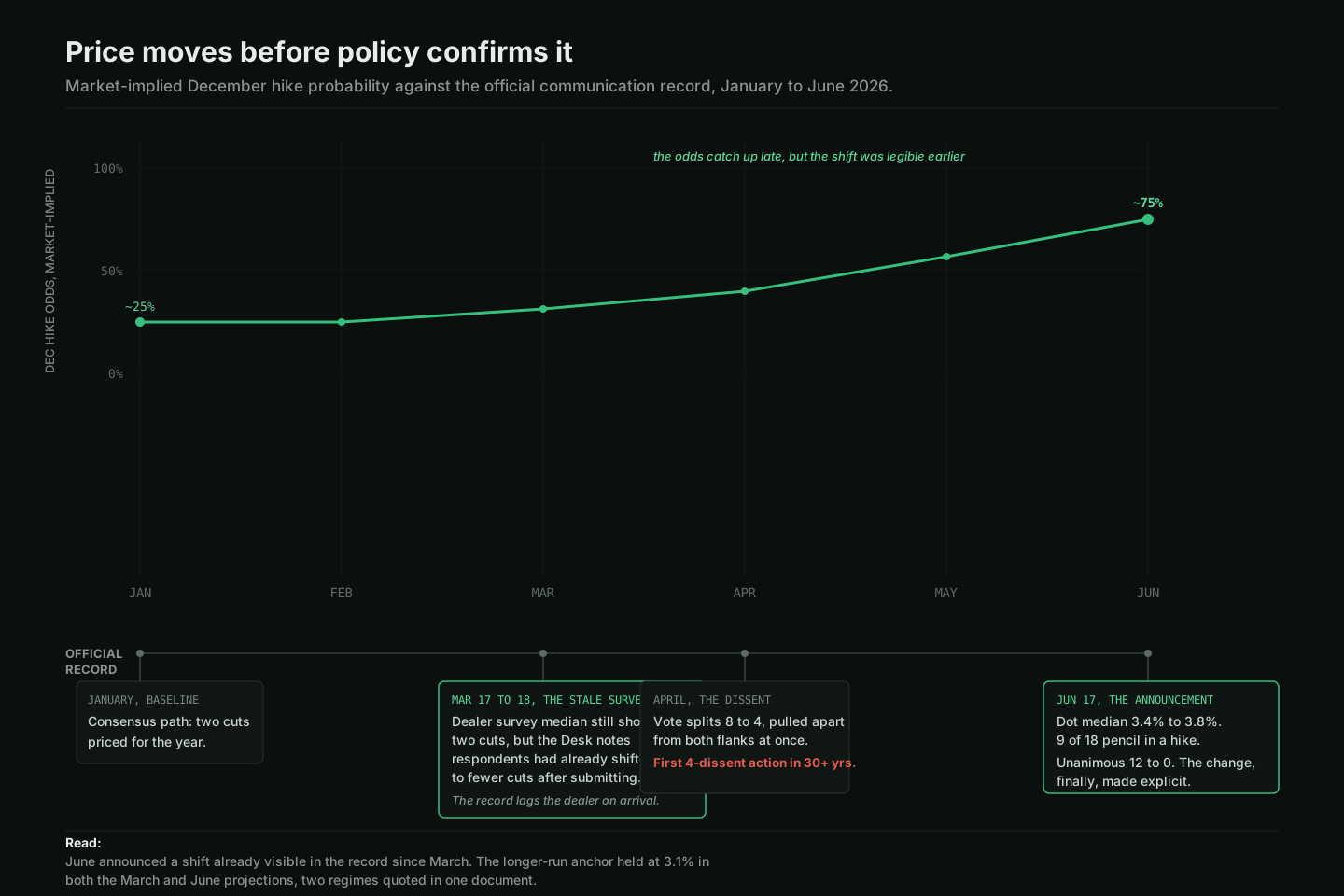
The consensus version of Q2 is that the Fed flipped hawkish in June. On June 17 the Committee held rates for a fourth straight meeting, the dot plot moved the year-end median from 3.4 percent to 3.8 percent, nine of eighteen officials put at least one hike on the board, and a new Chair delivered it unanimously, twelve to nothing. Futures went from pricing roughly a quarter odds of a December hike to something near three quarters within a month. Clean story. Incomplete emphasis.
Most people remember the day a bridge collapses. Engineers remember the cracks that showed up six months earlier, in an inspection report nobody read, describing a condition that was already well developed by the time anyone heard the noise. The collapse is the event. The cracks are the information. Structures become legible long before they become obvious.
The inspection reports here are the March and April minutes.
March planted the question. The Committee was already working through two-sided language, and the staff forecast, prepared before any participant opens their mouth, had already nudged inflation higher than January's. April exposed the disagreement. The vote came apart eight to four, and it came apart in both directions at once: one member dissenting because he wanted a cut, and three more dissenting not over the rate at all but because they refused to sign a statement carrying an easing bias. That is a committee pulled apart from both flanks in the same room, and it was the first four-dissent action in over three decades. June formalized the position that had become increasingly visible by April, and unanimity returned around it.
June wasn't the beginning of the story. It was the first time everyone else noticed it.
Part 3: Price before policy
There is a moment buried in the March minutes that does more work than the entire June press conference.
The Desk reported its survey of primary dealers to the Committee. The median path still showed two cuts this year. Then the manager added a qualification: market intelligence suggested some of those same respondents had already shifted toward fewer cuts in the days after they submitted the survey.
Read that again. The dealers' formal, written, submitted projections were already stale by the time they were read aloud to the people who set the rate. Not in hindsight. On arrival. The conditions had moved, the dealers had moved with them, and the official record was still carrying a view they had privately abandoned.
Official surveys have a remarkable ability to become outdated somewhere between being submitted and being published. Markets are rarely polite enough to wait.
This is the whole methodological point of watching positioning rather than commentary. Positioning doesn't tell you what anyone believes and it doesn't tell you why. It tells you how capital is currently arranged, which is a structural fact rather than an opinion, and structural facts are legible well before the institutions responsible for describing them get around to it. The survey lags the dealer. The minutes lag the survey. The dot plot lags the minutes. The commentary lags the dot plot. And somewhere at the front of that queue, price has been carrying the same information the entire time, available to anyone reading it rather than waiting to be told.
The practical version: when real-time pricing and official communication disagree, the communication usually has to catch up.
Policy eventually catches price. It rarely leads it.
Part 4: The market found another engine
Which leaves the obvious question. If policy tightened through the entire quarter, why did the index have its best run in five years?
Because the thing driving the market right now doesn't run on the Fed's fuel.
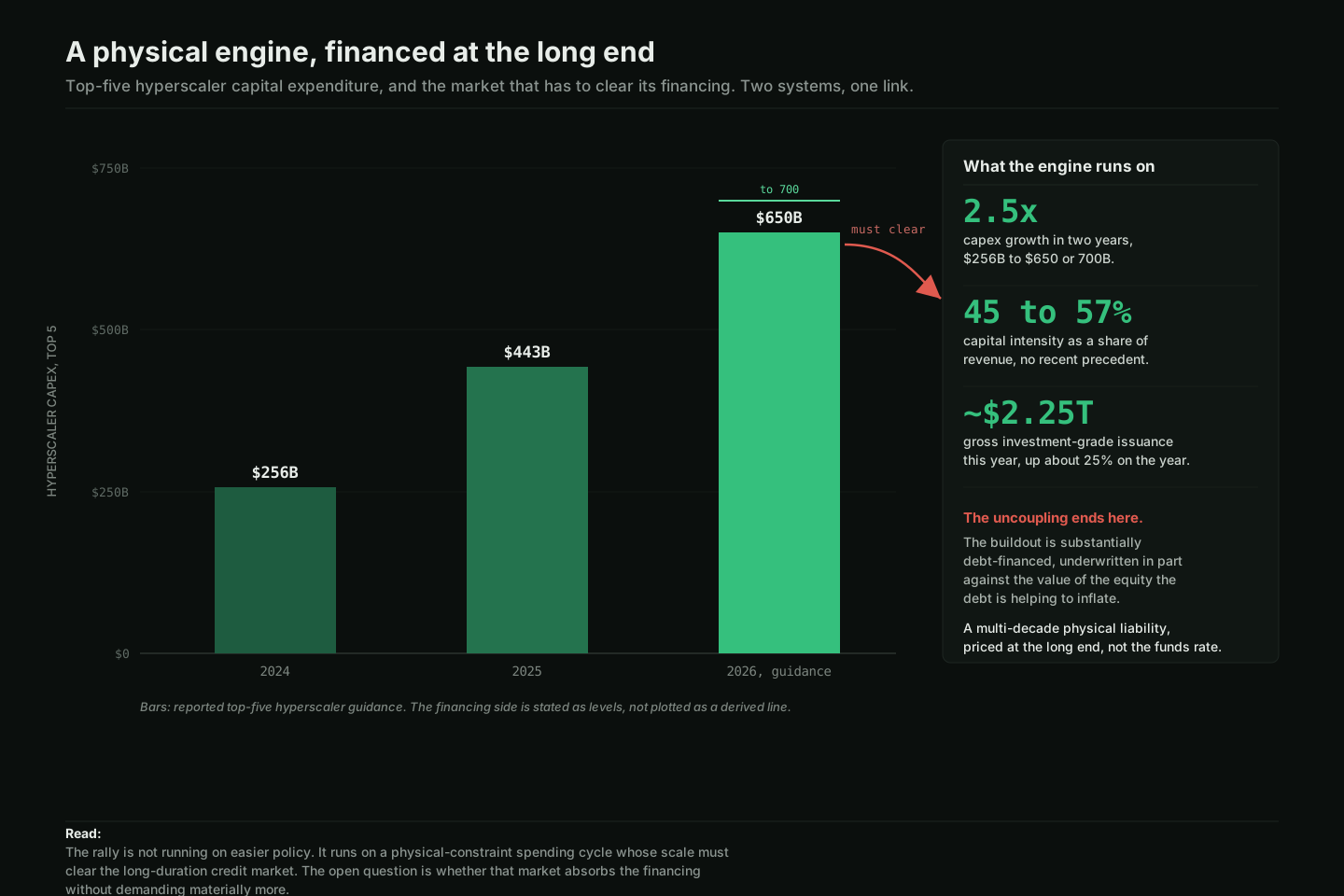
Top-five hyperscaler capital expenditure guidance for 2026 has moved into the range of $650 to $700 billion and above. That is against roughly $443 billion in 2025 and $256 billion the year before. Capital intensity at several of these companies is running between 45 and 57 percent of revenue, which has no recent precedent in corporate history. That is a decision by the largest balance sheets on earth to build physical infrastructure at a pace where the dominant constraint is currently capacity, not the marginal move in short-term rates.
And the reason it keeps working isn't that AI is exciting. Excitement isn't a mechanism. Scarcity is. Power, memory, cooling, interconnection, and the capital to fund all of it are the things in short supply, and short supply is what gets priced. Capital has spent the quarter rotating exactly along that logic: the binding constraint isn't ambition but whether anyone can actually get the parts.
So the equity rally and the hawkish Fed aren't a contradiction. They're two systems running on different power supplies, temporarily uncoupled.
Temporarily. The buildout is substantially debt-financed, with investment-grade issuance on pace for something like $2.25 trillion gross this year, up a quarter year over year. That debt is being underwritten in no small part against the value of the equity the debt is helping inflate. Which is where the uncoupling ends, because the price of long-duration credit for a multi-decade physical buildout is not set by the funds rate. It's set at the long end of the curve.
The story isn't artificial intelligence. The story is physical constraint, and physical constraint has to be financed.
Part 5: The quiet contradictions
When a regime changes, the most useful signals are rarely the ones confirming the headline. They're the ones showing where the old regime is still alive. Three of those appeared this quarter, and none of them competed for attention.
Housing inventory reached 10.3 months of supply in May, the highest reading since February 2009. That specific threshold has preceded a recession in six of the last seven times it appeared. None of that is AI-economy data. It's the rate-sensitive, non-mega-cap part of the country, still behaving exactly as the old regime says it should, decelerating for the entire stretch the index was making highs.
In private credit, payment-in-kind arrangements continued to be used to defer interest payments through the fourth quarter of 2025, concentrated in software. Deferring interest is what borrowers do when they cannot pay interest in cash. That is a structural footprint, quieter than a stock chart and largely undiscussed.
And AI-exposed job categories shed roughly eleven thousand positions a month across the trailing three months, with a record AI-linked layoff print in May. The temptation is to read that as a verdict on whether the technology works, which it isn't, and can't be this early. What it actually describes is a sequencing problem. The market is rewarding capital intensity now, ahead of productivity gains that remain largely unmeasured. The spending is immediate and the return is deferred, and the gap between them shows up in the labor data first.
None of these three interrupted the rally. All three are the same observation from different angles: the index has become a read on the handful of companies funding the capex cycle, while a second economy underneath keeps operating on the old rules.
Part 6: The resolution point
So the board looks like this. A committee whose position had shifted before it announced it. A market that had already arranged itself accordingly. An equity complex running on an engine the funds rate doesn't govern. And a real economy underneath, still priced to the previous regime.
Four moving parts, and they resolve at two prices.
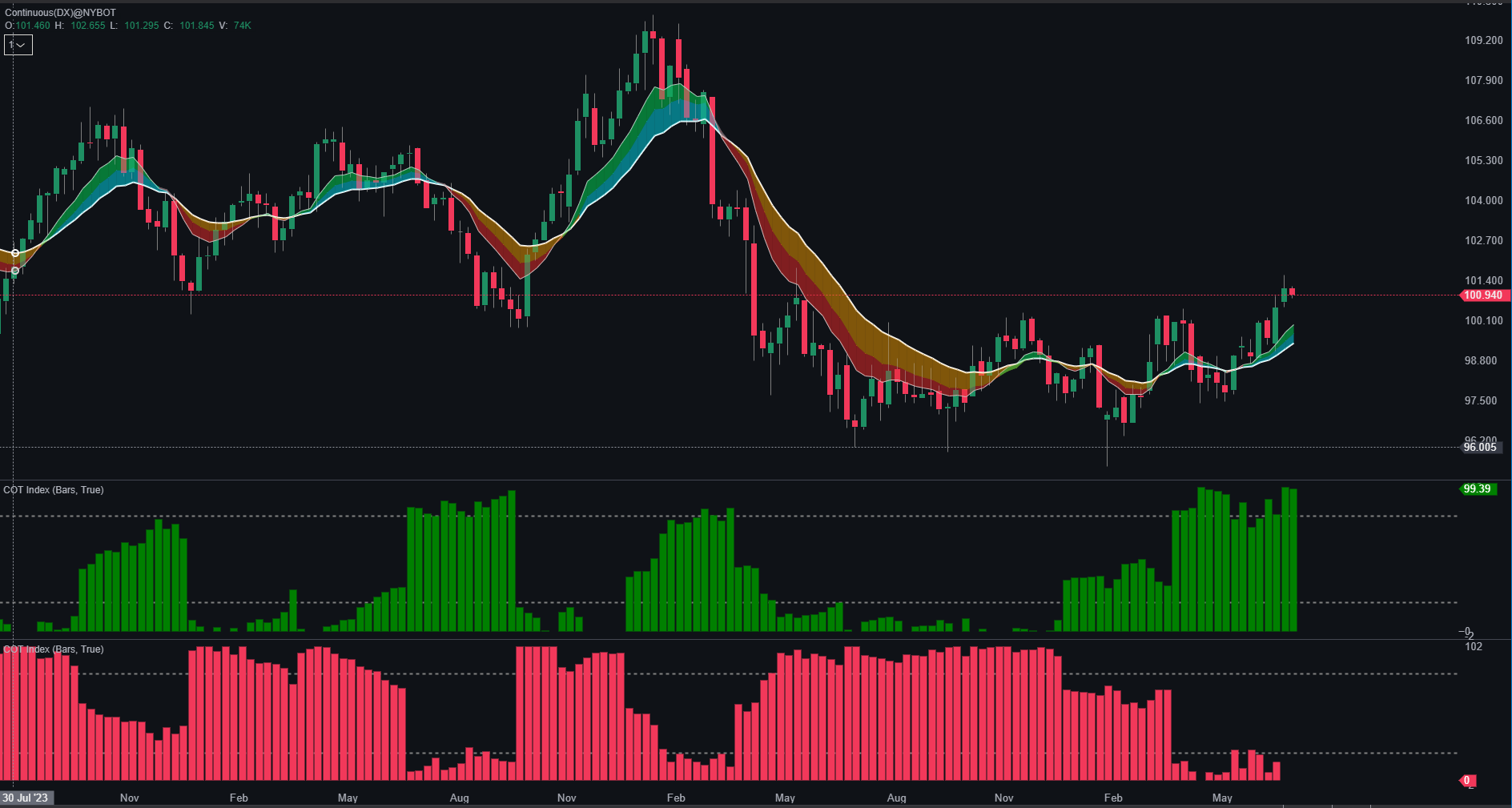
The dollar. The dollar is not a country's scoreboard, it's the price of global liquidity. Every asset funded in dollars and held outside them carries an exposure to it, whether or not the holder thinks of themselves as having a currency view. It is also the single transmission mechanism through which policy divergence expresses itself, which is what makes it the price to watch this quarter. There is no single global hawkish story. Policy paths are diverging, and the dollar is where those differences get reconciled into one number. Some central banks are tightening on domestic capacity while others keep cutting into the same energy shock, which hits exporters and importers in opposite directions. And the way the dollar got back here matters: the recovery has been bought by speculative money adding fresh long exposure, not backed into on fading interest, which is the makeup of an active repricing rather than a passive one. That repricing is not evenly distributed. The concentrated risk sits in a single cross. Speculative positioning in the yen is crowded short more one-sidedly than anywhere else on the board, which makes it the place a reversal in the dollar story would surface first and move hardest, because a crowd already pressed to that extreme has the least room left to add and the most exposure to a scramble the other way.
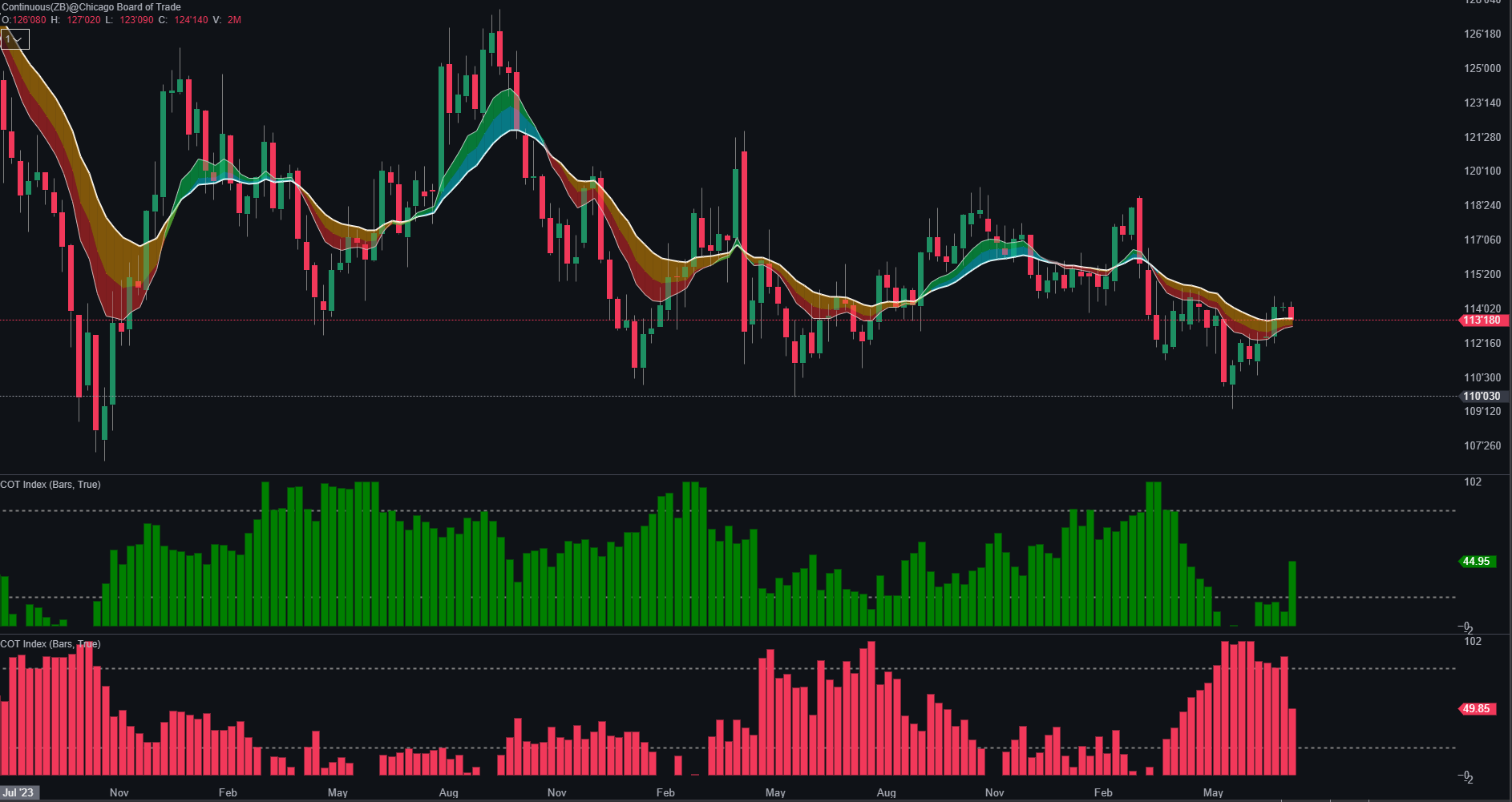
The 30-year. The long bond is the harder one, and the more important one, because most participants instinctively read it as a Fed instrument. It isn't. The funds rate is a policy decision. The 30-year is a price. The question at the front end is whether the Fed cuts. The question at the long end is a much larger one: what price does the world demand to finance this amount of debt?
That's the question the buildout in Part 4 hands to the market. A physically-constrained, multi-decade infrastructure cycle funded through record issuance is a long-duration liability whether or not anyone chooses to describe it that way, and the long end is the only place its true cost is quoted.
You can see the argument already sitting in how positioning is arranged across the curve. Speculative money is crowded to one extreme in the belly and the opposite extreme in the long bond. That isn't the makeup of a single view on the direction of rates. It's the makeup you get when near-term policy and long-duration financing are being priced as two separate questions, which is this section's argument showing up as structure rather than as a sentence.
The long end is also where that positioning is most one-sided, with the other side absorbed through dealer inventory rather than by anyone with a considered view on where the long bond belongs. That is what leaves it fragile rather than merely crowded, because a one-sided position unwinds fast when something forces it.
One reading elsewhere on the board speaks directly to this one. Commercials continue to accumulate in gold, and if that accumulation is describing what it appears to describe, it reinforces the debasement side of the dollar question and, with it, the case for the long end demanding more compensation rather than less. That is a condition to watch alongside the two prices, not a separate thesis.
If the dollar firms while the long end continues confirming tighter financial conditions, the current regime is intact and the uncoupling holds. If those two prices start disagreeing, the rest of the board becomes considerably harder to read, and that difficulty is itself the information.
Part 7: What would change our mind
One number in this record hasn't moved, and it's the one that should keep anyone honest about everything above.
The Committee's own longer-run rate anchor sits at 3.1 percent in the March projections and 3.1 percent in the June projections. Unchanged. That's the number that moves if the Committee believes any of this represents a structural change in the economy's inflationary tendency, because that is precisely what the number exists to express. It didn't move. Their revealed view is that this is a large temporary disturbance rather than a new world, while the market has priced the near-term path considerably further than that anchor supports. Two regimes, quoted simultaneously, in the same document.
The transition isn't finished. It's being argued out across prices right now.
So we hold it accordingly. This read weakens if the dollar and the long end start telling different stories. It weakens if a hyperscaler cuts full-year capex guidance rather than merely decelerating, because that breaks the engine from the supply side. It weakens if that 3.1 anchor moves in September, because the entire framing above rests on it not having done so.
A thesis you can't imagine being wrong isn't a thesis. It's a belief.
Part 8: The questions that matter
None of the above should be mistaken for an argument against equities. The structure we've described can coexist with considerably higher equity prices, and history suggests it often does. Markets have an inconvenient habit of remaining irrational longer than participants remain solvent, and we have no interest in arguing with price while price continues making higher highs.
The easiest way to lose money is to become intellectually attached to being right about a structural story while price disagrees with you in real time. Structure deserves respect. Price deserves obedience. That ordering matters, and it's the reason we don't begin with opinions. We begin with price, because price is the fastest mechanism we've found for aggregating information we don't yet have.
Which is the real purpose of this briefing, and it isn't a forecast.
Every quarter produces no shortage of forecasts. Some will be right, most won't. Markets are adaptive systems, and the inputs change faster than any forecast can track. I don't own a crystal ball. If I did, I'd spend considerably less time reading FOMC minutes.
So we don't leave the quarter with answers. We leave it with a scoreboard, and three questions we'll be watching resolve week by week.
Does the dollar keep confirming tighter global financial conditions, or does the policy divergence start to narrow? This is the one that tells you whether the uneven repricing across countries is still widening or has begun to converge. A dollar that keeps firming says the divergence has further to run and the transmission is still tightening. A dollar that stalls or reverses while the country paths pull back toward each other says the global argument is resolving, and the regime with it.
Does the long end absorb record financing needs without demanding materially higher compensation? The buildout has to be funded, and the funding has to clear at some price. If the long bond takes down record issuance quietly, the market is telling you the financing cost is a non-issue and the uncoupling holds. If it starts demanding more to show up, that's the financing constraint from Part 4 arriving at the only window where it gets quoted.
Does hyperscaler capital expenditure stay supply-constrained, or does the first evidence of demand saturation appear? Everything in Part 4 rests on the binding constraint being capacity rather than appetite. As long as the spending is gated by what can physically be built, the engine runs. The moment the gating factor becomes whether the demand justifies the build, the story changes from scarcity to something else entirely, and it changes at the source.
None of those three has an answer yet. That's the point. Good analysis isn't about predicting what comes next. It's about identifying the questions whose answers will matter most when they arrive.
Forecasts ask the future to cooperate. Frameworks ask us to adapt when it doesn't.
That's all for this one. I'll see you in the next.