For a long time, I wanted nothing to do with social media. I still don't post much. When I do, it's in short bursts, then nothing for a while. Privacy always felt like the safer default, and for years it was.
Here's the dichotomy. Social media is also where I found trading.
A handful of people online shaped how I trade more than most courses or books ever did, without any of them knowing it. (For those who care: WallStSavage, Carmine Rosato of Investitrade, XYZeeeTrades of OrderFlow Labs, Lukas Frohlich, best known as TheShortBear, and more). In every room I joined, I'd naturally find myself gravitating toward one or two people and just watching how they operated. Not the calls, but the thinking behind them.
Give a man a fish, and you feed him for a day. Teach a man to fish, and you feed him for a lifetime.
Closer to home, I had a small collective of people I knew and trusted that I'd share things with regularly. Market reads, half-formed ideas, or observations I was still working through. The feedback I got back wasn't just people being kiss-asses about it. It was substantive enough, and consistent enough, that I started to think there might be something worth putting out more broadly. I resisted that idea for a while. Trading was the one part of my life I kept entirely to myself, and I'd grown comfortable with that.
That reluctance sits oddly next to where this all started. I went to college to become a physical therapist, not a profession tied to wealth, but rather because I genuinely valued the idea of helping people work through, and even overcome something difficult. That was the plan. When markets eventually entered the picture, I showed up to them the way I'd shown up to everything else before: convinced that effort produces outcomes and that being right is parallel to winning. Soccer, swimming, martial arts. I'd spent most of my life in arenas where that logic held. I carried the mental model with me, intact, directly into the one arena where it didn't.
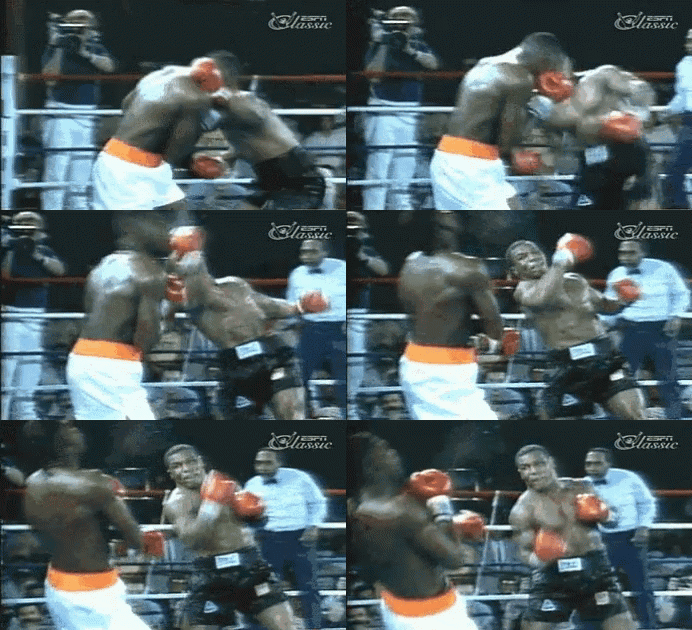
This was approximately the equivalent of stepping into the ring with prime Mike Tyson as someone who has never boxed a day in their life, but has a background in curling. In other words, you are utterly f*cked, and as Tyson himself has famously said: "everyone's got a plan until they get punched in the face."
Markets don't care about your plan, your opinion, or how long you've been studying. It's not a competition in any sense I recognized coming in, because there's no opponent. The market doesn't know you exist, and whatever happens in your account stays between you and the screen. Trading is ultimately a you-versus-you game. The market itself is an information problem: participants with different objectives, different time horizons, and different positioning all interacting in the same place at the same time. Recognizing this early changes the objective from predicting outcomes to understanding the structure of the game itself, which is where durable frameworks and enduring advantages are built. (Or so I found out).
Somewhere in that stretch there's a day every trader has a version of. Mine was a FOMC afternoon in late March of 2023. I was executing a system I'd picked up from one of my early mentors: a bidirectional play designed to capture the mispricing of volatility in options contracts around large macro-economic events, also known as a straddle or a strangle. Generally speaking, it had a higher than average hit-rate and an asymmetric return profile, the kind of setup that sounds good on paper because it actually is.
But again, the market simply does not give a shit. It transacts in whatever direction offers the least resistance, and what I hadn't yet realized, nor was capable of predicting, was that in this particular event's case, it was nowhere. A dud. An outlier in the data. Nonetheless, I had leveraged myself far more than I should have. I doubt I need to continue with this story for you to get the gist, but across the span of about sixty-five minutes, I had blown up more than sixty percent of my all-time P&L, in one blink of a decision.
Moments like this are inevitable in every trader's journey. If you haven't had one (or even multiple) yet, you either haven't been playing long enough, aren't taking significant enough risk, or you possess a magic eight-ball that miraculously prevents you from personally-induced errors, in which case I'd genuinely love your contact information.
What these moments represent is stored potential, which is unrealized and inert until the point that we, the participants in the game, choose to act on it. A miniscule percent of the population will use these moments as catalysts for evolution and for post-traumatic growth to take place; others erode, whittle, or crack under their own fragility, unable to survive long enough to reap the rewards.
After that gut-wrenching face-off in the markets, I started looking for answers in places that had nothing to do with trading. That's how I ended up reading Essentialism, a book with no relationship to the markets that ended up mattering more than most of the ones that did. The entire central idea fit on an index card: most of what you do contributes almost nothing, a small fraction of it contributes almost everything, and the job is figuring out which is which and committing to it. More simply put: less, but better. I'd heard some version of that before. This was the first time it actually rewired how I operated, and it's the reason this company is named what it is. EightyTwentyVentures isn't a name I picked because it sounded sharp. It's the operating principle.
In practice, that looks like losing more than I win. My win rate fluctuates generally below fifty percent, and whenever that comes up in conversation, people flinch. What actually works isn't being right more often. It's losing small, staying in the game, and letting the rare setups pay disproportionately when they show up. That's the whole edge, and it's less complicated than it first appears.
EightyTwentyVentures didn't start as a free site. It started as a paid newsletter, a small list, something I built quietly and didn't think too hard about. What changed my mind wasn't a marketing decision. I kept thinking about a couple of people outside of markets entirely who'd changed how I thought about almost everything and never charged me a dollar for it. I kept thinking about that small group locally who'd told me my thinking was worth sharing.
Eventually charging people for the same kind of thing that had been given to me for free stopped making sense. So I converted it. If putting this out for free helps even one person skip a year of what I went through, that's the entire bet.
None of this is finished. I'm still trading, still adjusting both playbooks as conditions change underneath them, still figuring out how to fold a few thousand hours of screen time into something more systematic than gut feel.
What's here now exists mostly because a few people I trusted insisted it was worth doing, and I eventually believed them. If you've read this far and recognized yourself somewhere in it, you're probably exactly who this was built for.