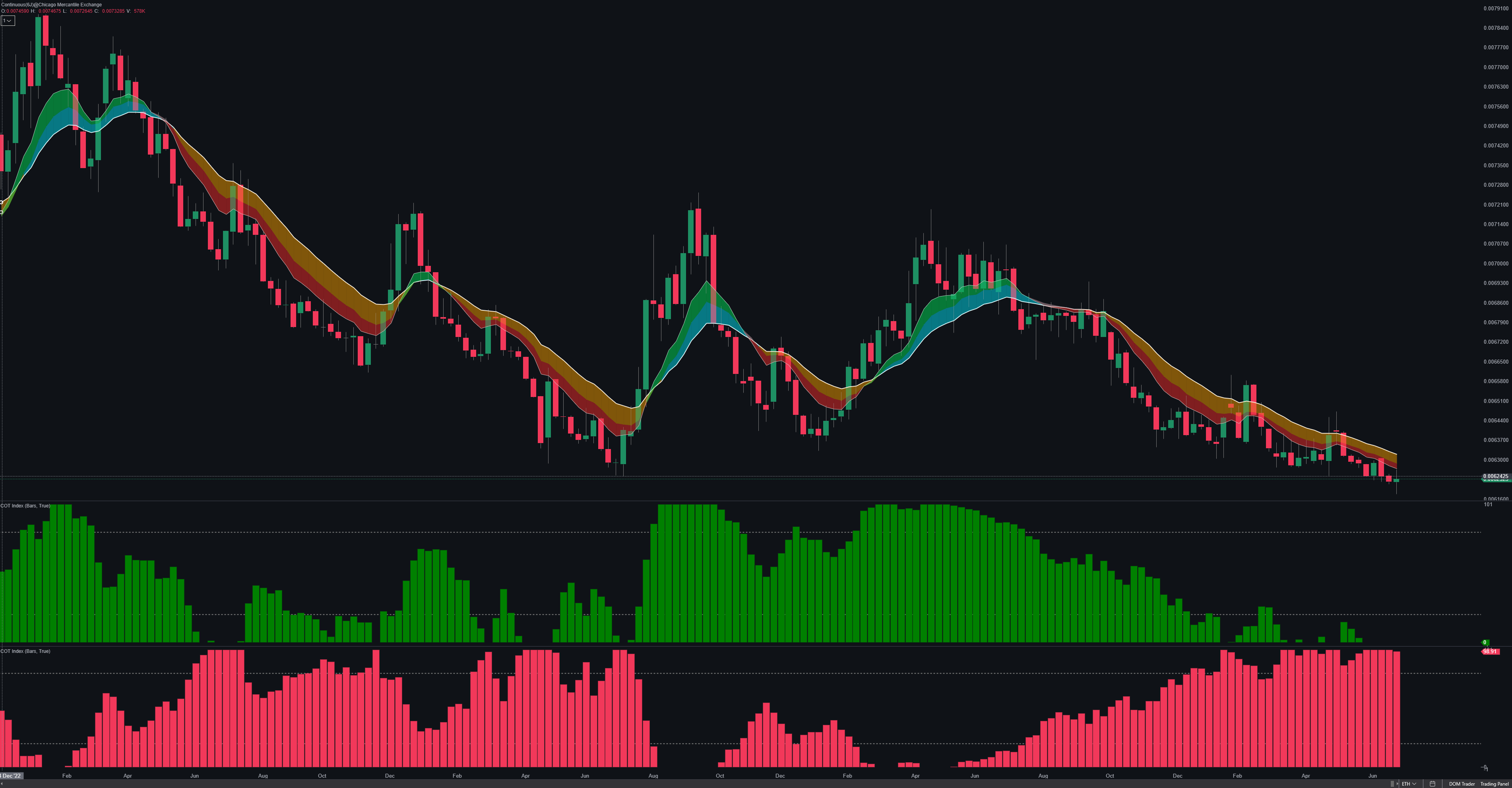
Japan spent the first half of 2026 doing almost everything the textbook recommends when a currency is under pressure.
The Ministry of Finance deployed ¥11.7 trillion in May, roughly $73.5 billion, in what became its largest intervention on record. A sharp appreciation in the yen on April 30 was widely viewed as an earlier attempt, and on June 16 the Bank of Japan raised its policy rate by 25 basis points to 1 percent, its highest level since 1995.
Two weeks later, the yen reached its weakest level in forty years.
The useful question is not why the defense failed. It is what a public failure teaches the participants who have spent months betting against it.
The rest of this briefing is for readers on the list.
Free, permanently. Enter your email and a link comes back that unlocks every piece on the site, current and future.
Part I: What ¥11.7 trillion bought
Foreign-exchange intervention has a limitation that determination cannot overcome. Japan's reserve holdings are finite, their approximate size is public, and the cost of each defense eventually becomes known.
Everyone taking the other side can do the same arithmetic.
Officials can create uncertainty around the timing and size of the next intervention, but they cannot hide the resources available to them. The market may not know when Japan will act again, but it can estimate how much each attempt costs and how often an effort of that size can be repeated.
It is a defense conducted with the cards face up. The defender can bluff about willingness, but not about the number of chips remaining.
That does not make intervention meaningless. It can interrupt momentum, force leveraged traders to reduce exposure, and create sharp temporary moves. What it has not done is repair the underlying imbalance supporting the weaker yen.
Roughly $73.5 billion bought time. It did not change the terms of the trade.
The argument, then, is not that Tokyo will eventually overpower the market by spending more. Intervention matters here for a different reason. It introduces sudden pressure into a market where an unusually large number of participants are relying on the same direction continuing without interruption.
Part II: The hike that was already in the price
A rate increase should normally support a currency. Higher rates make holding that currency more attractive and reduce some of the advantage available elsewhere.
The yen reached a forty-year low shortly after the Bank of Japan raised rates.
Taken alone, that looks like a familiar warning. Supportive news arrived, the market failed to respond, and the existing weakness remained intact. But that interpretation depends on the announcement changing what participants knew.
This one did not.
The increase had been widely reported before the meeting and matched the outcome economists expected. Traders did not have to wait for the formal decision to adjust their exposure. By the time the Bank of Japan confirmed the move, the market had already spent several days trading as though it would happen.
The yen therefore did not reject a surprise. It absorbed the confirmation of something that had already been assumed.
That distinction changes the meaning of the decline. It does not necessarily show that the rate increase was irrelevant or that a new wave of selling had begun. It shows that the policy adjustment was not large enough to disturb an argument the market already understood.
The rate differential remained wide, the existing trend remained intact, and nearly everyone trading that relationship had already seen the same evidence.
The story had not been disproved. It had become thoroughly occupied.
Part III: Crowded is not the same as wrong
Positioning across the dollar, yen, and euro shows how concentrated that view has become. Speculators are heavily committed to a stronger dollar and a weaker yen, while commercial exposure sits near the opposite end of its historical range. Separate data also places speculative yen shorts near their most elevated levels in several years.
This is not a minor lean. It is a market arranged around one dominant conclusion.
Open interest makes the condition different from the one observed in silver. There, participation contracted as price declined, which suggested positions were being closed and leverage was leaving the market. Here, participation is increasing while the positioning imbalance grows.
More traders are entering, more exposure is being created, and more capital is becoming dependent on the same outcome.
They have a sensible reason for doing so. The gap between US and Japanese interest rates remains wide, and holding dollars continues to offer a meaningful yield advantage over holding yen. That difference has supported the trend, explained the position, and rewarded the participants who adopted it.
Nothing in the positioning data makes that argument false.
The risk comes from the number of traders who now share it. A fundamentally justified position can still become vulnerable when nearly every participant has reached the same conclusion and expressed it in the same direction.
Crowding is not evidence that the market is mistaken. It is evidence that the market has become dependent on continued agreement.
That dependence changes the shape of the risk. The underlying policy gap does not need to disappear for the yen to strengthen sharply. A temporary disruption may be enough to force some traders to reduce exposure, and once that process begins, the size of the position can become more important than the original reason for holding it.
The thesis can remain intact while the trade becomes unstable.
Part IV: Why the condition may persist
The strongest argument against an immediate change in the yen arrived during the same month as the Bank of Japan hike. The Federal Reserve's June projections moved the expected year-end policy rate higher, and nearly half of officials projected additional increases.
That matters because the interest-rate gap remains the main support beneath the position. Another Federal Reserve hike would widen that gap, reinforce the case for holding dollars, and give the existing trend more room to continue.
The positioning could become more extreme before it becomes restrictive.
This is why the present condition should be understood as fragility rather than reversal. The data does not identify the end of the trend, and it cannot tell us when traders will begin reducing exposure. It shows that the position has grown large enough for a routine interruption to produce an unusual reaction.
A crowded market can remain crowded for longer than seems reasonable, especially when the economics continue to reward it. The vulnerability only becomes visible when the market is given another reason to extend and cannot do so cleanly.
Until then, congestion is a condition. It is not a turning point.
Part V: What would reveal the pressure
The clearest evidence would be another development that normally supports the dollar, followed by little or no extension in the yen's decline. A stronger inflation report, a more restrictive Federal Reserve message, or another rise in US yields would each provide the market with a familiar reason to continue the trade.
The important information would come from what happened afterward. If new support for the dollar produced less movement than it had before, the trade would be showing diminishing sensitivity to the argument that built it.
That would not mean the rate differential had disappeared. It would mean the existing position had become so well populated that additional confirmation was struggling to attract enough fresh exposure.
The euro should reflect the same process from the opposite direction. Because it carries the largest weight in the Dollar Index, a broader reduction in dollar exposure should appear as greater resilience in the euro alongside improvement in the yen.
The interpretation would weaken if dollar open interest continued expanding alongside clear new highs. That would show that additional participants were still entering and that the position retained the capacity to grow. Further yen weakness accompanied by rising participation would carry the same message.
In that case, the market would not be trapped. It would still be building.
Another Japanese intervention may provide the cleanest test. Not because intervention is likely to close the interest-rate gap or create a lasting recovery, but because it would introduce forced movement into a market carrying an unusually large amount of one-way exposure.
When positions are small, traders can reduce them without changing the market. When the same position is held across the room, leaving becomes part of the price.
Japan's defense may continue to fail on its own terms. It does not need to reverse the currency to reveal the structure standing against it.
The cards are already face up.
The remaining question is what happens when everyone reaches for the same exit.