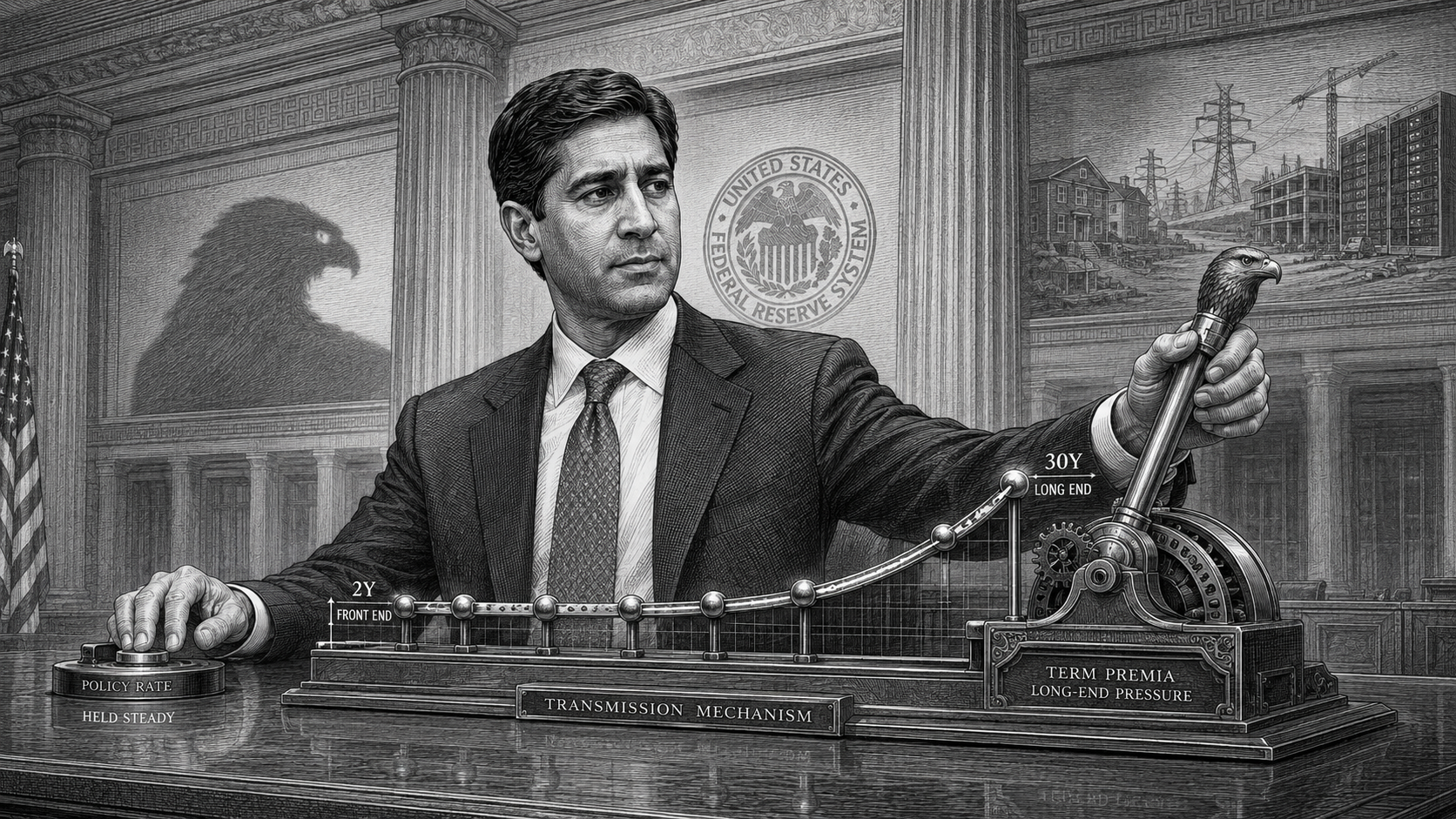
On July 29, the Federal Reserve left interest rates unchanged for the fifth meeting in a row. That was the least important part of the day.
Chairman Warsh then spent much of his press conference talking about what had happened in the bond market since the Fed's previous meeting. Long-term yields had risen sharply. Mortgages had become more expensive. Companies borrowing for years at a time were paying more. Warsh treated those changes as real tightening, even though the Fed itself had not raised its rate.
The rate was held. The lever moved.
The Fed controls short-term rates. The bond market sets longer-term ones. Where that pressure landed matters. A normal Fed rate increase hits short-term loans, floating-rate debt and bank funding first. Higher long-term yields hit mortgages, infrastructure and long-term corporate borrowing instead. Bond investors call part of that extra cost the term premium: the price they demand for taking the risk that conditions could change before they are repaid. Some of the largest new demands on that market are coming from companies financing the AI infrastructure buildout.
The quarterly briefing argued that the dollar and the 30-year Treasury would be the two prices that mattered most this quarter. It also argued that the true cost of the AI buildout would eventually appear in long-term financing rather than in the Fed's short-term rate. Five days on from the meeting, July 29 still looks like the clearest example yet of how those ideas connect.
The Fed is counting market-led tightening as part of its assessment of financial conditions, and treating that tightening as a reason for patience. A meaningful share of that pressure is landing directly on the capital cycle currently supporting growth.
The rest of this briefing is for readers on the list.
Free, permanently. Enter your email and a link comes back that unlocks every piece on the site, current and future.
Part I: The Anomaly
Three things happened on July 29 that would not ordinarily be expected to happen together. Brent crude settled at $90.74, up 7.9 percent on the day. Three Fed officials formally called for an immediate quarter-point rate increase. Yet the 2-year Treasury yield fell and the dollar weakened by roughly 0.3 percent.
Put the first two facts together and you get about as hawkish a combination as markets ordinarily see: a sharp rise in the most important near-term inflation input, three officials pushing for an immediate hike, and more than five years of inflation running above target behind both. A shock like that would normally push short-term yields higher because it raises the probability of a Fed response. It would usually support the dollar for the same reason.
Almost everything else on the tape registered the shock. The 30-year Treasury yield crossed 5.20 percent for the first time since 2007. The S&P 500 fell 1.5 percent, the Dow fell 2.2 percent and the Nasdaq Composite fell 1.7 percent. The Nasdaq 100 dropped 2.1 percent and moved into correction territory, ending the session roughly 11 percent below its June record.
Two parts of the market moved differently. Short-term yields fell, and the dollar weakened. Together, those moves show that investors were not simply pricing a larger inflation problem. They were also marking down the speed of the Fed's likely response.
The oil shock helped explain the broad risk-off move. It does not fully explain the part of the session tied to what investors expected the Fed to do next.
Part II: What the Market Heard
Before the meeting, markets placed roughly a one-in-three probability on an immediate July rate increase. Conditional on the Fed holding in July, pricing implied that a September increase was close to certain. After the decision, CME pricing placed the probability of a September increase near 57 percent, even though oil had risen almost 8 percent that day.
The exact intraday probability varied with the timestamp. The direction did not. The decision cycle left investors less convinced that the Fed would respond quickly.
The press conference did not tell investors what the Fed would do. It told them that one inflation report would not be enough, that Warsh wanted to see whether an oil or supply shock spread into the rest of the economy, and that the Committee would not allow market pricing to dictate its decision.
Economists call this the Fed's reaction function: the way new information becomes policy. Warsh did not eliminate that process. He made it less automatic and less visible.
The goal behind that is reasonable. When the Fed gives markets constant guidance, market prices can begin repeating what officials have already said. Giving less guidance may allow prices to reveal more about the economy on their own.
But silence has a cost. When investors become less certain about how the Fed will respond, they may demand more compensation for holding long-term debt. The Fed can then count those higher yields as evidence that financial conditions have tightened, even though part of the move reflects uncertainty surrounding the Fed's own reaction function. Part of what the Fed is reading back is the market's view of the economy. Part of it is the market's view of the silence.
Warsh did not describe this as outsourcing policy to the bond market. He did, however, explicitly describe the increase in nominal and real yields as material tightening and later said that tighter financial conditions had provided the Committee with some comfort.
The cleaner conclusion is that the Fed is counting market-led tightening as part of its assessment of financial conditions.
Part III: Where the Risk Moved
Inflation risk did not disappear when the 2-year yield fell. The adjustment moved farther out along the curve.
Investors became less convinced that the Fed would respond quickly, while the market demanded more compensation to hold longer-term debt. That creates a different form of pressure than a conventional Fed hike. A policy-rate increase reaches short-term loans, floating-rate debt and bank funding first. A rise in long-term yields reaches mortgages, infrastructure projects and long-duration corporate borrowing more directly.
Both can tighten the economy. They land on different borrowers.
The combination of a weaker dollar, a falling 2-year yield and a sharply steeper curve was consistent with investors marking down the speed of the Fed's response while demanding more compensation farther out the curve. That interpretation fits the price action. It does not prove that term premium alone caused it.
The effects are already visible where this argument says they should be. Thirty-year mortgage rates reached 6.66 percent in the week ending July 30, up from 6.58 percent one week earlier. Long-term corporate borrowing spreads had also widened, while the benchmark rates most closely tied to short-dated and floating-rate credit moved lower during the July 29 session.
Part IV: Who Absorbs It
This matters because the AI buildout requires enormous spending before the projects being financed can establish their eventual returns.
Technology companies are committing hundreds of billions of dollars to data centers, power, construction, networking equipment and computing infrastructure. Fitch projected combined 2026 capital spending by Alphabet, Amazon, Meta and Microsoft near $700 billion, a figure that lines up with the scale the quarterly briefing flagged earlier this year. The money must be spent before the full economic return is known, which makes project economics increasingly sensitive to long-term financing costs.
A company paying slightly more interest on an established business can often absorb it. A new project whose economics depend on financing billions of dollars today is more exposed. A modest increase in the discount rate can materially change which projects still clear the required return.
By late July, Fitch said Amazon, Alphabet, Nvidia, Meta, Oracle and SpaceX had collectively issued roughly $182 billion of investment-grade bonds. That borrowing does not mean the group has exhausted its internal cash generation. It shows that external capital is becoming a larger part of financing the buildout as capital spending places greater pressure on free cash flow. Current estimates suggest that five major hyperscalers could spend more on capital expenditures than they generate in free cash flow by 2027.
The cost of that capital has already begun to rise. Across 91 hyperscaler bonds issued in 2026 with comparable pricing data, 78 were trading at higher yields by July 28 than when they were issued. The median increase was approximately 22 basis points.
Investor demand remained available, but it had become more selective. Cover ratios on hyperscaler bond sales fell from nearly five times in February to below two times in July. The market was still absorbing the debt. It was charging more and showing less enthusiasm while doing so.
Warsh pointed to rising prices for memory chips, logic chips and associated AI infrastructure. Chips are one constraint, but not the only one. The buildout must also secure electricity, grid connections, generation equipment, construction capacity and skilled labor. Several of those constraints must be resolved domestically, and increasingly the financing for them is being priced in the same long-term credit markets described here.
The Fed did not start the repricing of AI credit. July 29 added long-end pressure to a market that was already becoming more selective.
Part V: What Would Confirm or Break This
Financial conditions tightened materially between the June and July Fed meetings. The 10-year real Treasury yield rose from 2.23 percent on June 17 to 2.41 percent on July 29, while the 10-year breakeven inflation rate was 2.26 percent on both dates. That supports Warsh's claim that much of the intermeeting tightening came through higher real borrowing costs rather than a broad loss of confidence in long-run inflation control.
The July 29 session itself was different. Ten-year inflation compensation rose from 2.20 percent on July 28 to 2.26 percent on July 29 and reached 2.28 percent by July 31. The immediate selloff therefore cannot be described as purely a real-yield or term-premium move. The cleaner distinction is that the full intermeeting tightening was led by real rates, while the reaction to the meeting also contained a measurable increase in inflation compensation.
The next test may come from the composition of the Fed's balance sheet. Runoff ended on December 1, 2025, and total assets subsequently rose from roughly $6.54 trillion to approximately $6.75 trillion by July 22. That increase largely reflected publicly announced reserve-management purchases and reinvestments into Treasury bills, not an effort to suppress long-term borrowing costs. The more meaningful signal would be a shift toward longer-duration securities, or another policy change that materially reduced the amount of long-dated debt private investors must absorb.
The first follow-through has been mixed. By August 3, Brent had fallen 4.9 percent to $83.64, the 10-year Treasury yield had retreated to approximately 4.69 percent and the 30-year had declined to roughly 5.23 percent after reaching 5.28 percent on Friday. The dollar index rose 0.24 percent during the August 3 session to 99.95, so it did not weaken further that day, although it remained below its pre-meeting level.
The oil component partially reversed. The long end remained elevated. The dollar had not recovered the ground lost around the meeting. That is not a clean reversal of the July 29 signal, but neither is it uninterrupted confirmation.
There is a feedback loop underneath all of this, worth stating without overstating it. If higher long-term borrowing costs slow AI investment, some of the demand pressure on power, construction and computing infrastructure may ease. That could reduce the case for a policy-rate increase and eventually make financing cheaper again. The mechanism does not need to repeat on a fixed schedule. The point is that the Fed is now counting a form of tightening that it can influence but does not fully control.
The quarterly briefing left one question open for exactly this stretch of the calendar: can the long end absorb record financing needs without demanding materially higher compensation?
July 29 is not the full answer. It is the first clear illustration of the channel. The long end absorbed the financing pressure. It did not absorb it quietly.
Three developments would tell us whether this reading is right. It would weaken if long-term yields returned materially toward their pre-conflict levels without a change in the policy rate. It would weaken further if AI investment continued expanding without hesitation through several more months of higher long-term borrowing costs. The next unexpectedly high inflation report would provide the cleanest early test. A sharp increase in short-term yields and a stronger dollar would show that markets still expect the Fed to respond quickly. Another combination of rising long-term yields, a steeper curve and a dollar that fails to strengthen would support the view that more of the adjustment is occurring through the price of long-term risk.
One report will not settle it. A repeated pattern would.
Warsh may be right that market prices carry more information when the Fed says less. But the tightening he is now counting in the policy ledger is being set by a market the Fed influences without fully controlling, and it is landing directly on the capital cycle currently supporting growth.