
Part 1: Risk is a performance activity
Before I ever expected financial markets to become my career, I was on a very different path. I was preparing to become a physical therapist, and physiology was probably my first real intellectual love. I was fascinated by the body as a system, by how structures adapt to load, how stress changes performance, how recovery changes future capacity, and how an outcome that appears isolated usually makes more sense once you understand the mechanisms underneath it.
Markets eventually replaced physical therapy as the career, but that way of thinking never really left. If anything, trading gave physiology a more interesting application. A discretionary trader operates inside an environment rooted in uncertainty, competition, anticipation, reward, threat, incomplete information, and consequence. We usually describe what happens inside that environment through the vocabulary of trading psychology like fear, greed, confidence, tilt, conviction, patience, and discipline. They are useful descriptions, but they often describe the symptom rather than the mechanism producing it.
This is not unique to trading. High-level athletes, surgeons, musicians, drivers, fighters, and other performers operate inside similar loops. They perceive information, anticipate what may happen next, mobilize physiological resources, act with respect to consequence, receive feedback, and update. The activity may be different, but many of the neural and physiological systems involved in attention, arousal, movement preparation, threat detection, pattern recognition, and recovery overlap. That is part of why experienced performance can look almost intuitive from the outside. The expert often recognizes that something has changed before they can fully explain every variable that produced the recognition, because the body and brain are continuously processing information outside conscious awareness, comparing what is happening now with prior experience, and preparing us toward or away from action.
We spend most of any given trading session asking whether the market has changed. Has participation changed? Has the auction moved from balance into discovery? Has volatility expanded? Has behavior around a reference changed enough to invalidate what we believed twenty minutes ago? We accept almost automatically that the environment is dynamic, and that a read formed before the open can become useless later because the facts themselves have changed.
What we are slower to acknowledge is that the person interpreting those facts changes too. A trader can look at uncertainty early in a session and see information that needs to be processed, then encounter almost identical uncertainty later and experience it as either opportunity or danger depending on what has happened between those two moments. The chart may have changed somewhat, but so has the person reading it. Risk does not merely present a problem for the decision-maker to solve; exposure to risk can modify the decision-maker who will be responsible for solving the next one.
I think of that movement as a pendulum. Throughout a session, reward, loss, boredom, uncertainty, fatigue, confidence, and stress are continuously applying force, so the trader is rarely sitting at some perfectly neutral center. He is being pulled. The objective is not to stop the pendulum from moving, but to prevent ordinary movement from becoming a swing large enough to quietly change how we see the market.
That is the loop worth understanding. Risk changes physiology, physiology influences perception and behavior, those changes affect how the next exposure to risk is interpreted, and the next outcome feeds back into the system again. Once viewed this way, the individual trade stops being the only useful unit of analysis, because the sequence of decisions is continuously changing the observer.
The rest of this briefing is for readers on the list.
Free, permanently. Enter your email and a link comes back that unlocks every piece on the site, current and future.
Part 2: Every decision changes the next one
John Coates spent years inside financial markets before studying the biology of financial risk-taking. His book, The Hour Between Dog and Wolf, became the central source behind this piece because it asks essentially the same question we are trying to answer here: what happens when the person taking financial risk is not biologically separate from the risk itself? Rather than treating traders as fixed rational observers occasionally interrupted by emotion, Coates examined how reward, stress, hormones, arousal, and uncertainty interact with the person making the next decision.
The useful idea is not that any single hormone explains why somebody trades badly, but that the decision-maker should not be treated as a constant. Imagine the same clean retracement into a meaningful reference appearing twice in one morning. At 9:40, the trader is fresh, so he waits for the reaction, sees the behavior he wanted, defines the invalidation, and takes the trade.
At 11:15, almost the same opportunity appears, except that between those moments he has taken two losses, watched a missed trade run without him, and spent an hour staring at a market that refused to behave as expected. The setup can be structurally similar while the person evaluating it is not. Perhaps he now requires so much confirmation that the opportunity passes, perhaps he enters too early because he refuses to miss another move, or perhaps normal adverse excursion suddenly feels like evidence that the trade is wrong.
The chart alone cannot explain the difference. Decision number six is being made by somebody who has already lived through decisions one through five, and while the written plan may still be untouched beside the keyboard, the operator interpreting it is not. That changes the practical question. We should still ask whether the market has changed, but we also have to ask whether the pendulum has moved far enough that we are no longer interpreting the market from roughly the same place.
Part 3: Winning changes what we see
Winning is deceptive because the state it produces often feels useful. A sequence of successful decisions can increase confidence, reduce hesitation, and make risk easier to carry, and research around what is known as the winner effect suggests that winning can alter subsequent risk-taking without demonstrating an equivalent improvement in decision quality. That is the part that matters, because increased willingness to take risk is not the same thing as increased edge.
Suppose the first two trades of the morning came from excellent locations and worked immediately. An hour later, price reaches a third area that is less clear, and under ordinary circumstances the trader might wait. Then a quiet thought appears: I am seeing this well today. Nothing about the third setup improved because the first two made money, but the threshold for action did.
Recent success can reflect good process, favorable conditions, variance, improvement, or some combination of them, and the nervous system does not wait for us to separate those variables before responding. Success can also make continued participation more attractive, because markets continuously offer unresolved possibilities. Another level is approaching, another breakout may begin, another trade may appear, and even after the original opportunity set has weakened, the possibility of another resolution keeps the screen interesting.
That gives us a useful distinction: wanting another decision is not evidence that another valid decision exists. The danger of winning is that the pendulum can move while everything feels good.
Part 4: Losing changes what we see
Loss can move the threshold in the opposite direction. Acute stress is not inherently dysfunctional, and some arousal is part of normal performance, so the problem becomes more relevant only when stress persists. Coates' research, along with later controlled work, suggests that sustained physiological stress can alter how people evaluate risk and uncertainty. For a trader, the practical implication matters more than the exact mechanism, because the same uncertainty can begin to feel different after enough adverse exposure.
Take two legitimate losses early in the session. The next setup meets the plan: location is correct, structure remains intact, invalidation is clear. But every tick against the position now feels unusually important. The trader who was comfortable acting on imperfect information at 9:35 suddenly wants another candle, another confirmation, another piece of order flow, and by the time the trade finally feels safe, the asymmetry is gone.
Someone else responds to the same losses by becoming aggressive. Waiting leaves the losses unresolved, so action begins to offer something the market itself did not: the possibility of restoring control. One trader retreats from uncertainty while the other tries to overpower it, but in both cases the next trade has started serving two purposes. It is expressing a market view and regulating an internal state at the same time.
At the far end of that spectrum is what traders usually call tilt, and anyone who has experienced it knows how strange it can feel in hindsight. For a few minutes, it is almost an out-of-body experience. The market is no longer something to interpret; it has somehow become an opponent, and the only thing that seems to matter is getting back at it. If the market were a real person, there are moments when we would probably like to beat it into a pulp. Unfortunately, it is not a person but a machine, so getting genuinely angry at it is about as rational as a toddler losing his mind because somebody took away his lollipop. The uncomfortable part is realizing that, in this analogy, we are the toddler.
That sounds ridiculous once the episode is over, which is partly why the example matters. Inside the state, the anger feels completely justified, because the market did something to us and another trade begins to feel like the way to answer it. Nothing about the auction requires that response. The pendulum has simply moved far enough that an internal problem has been mistaken for a market problem.
Coates describes hormones as lobbyists rather than dictators, and I like that distinction. Biology applies pressure, but it does not make the final decision. The trader is still responsible for the click, and understanding the pressure simply makes that responsibility more useful.
Part 5: Good trading often requires tolerating the wrong feeling
The action that produces the fastest emotional relief is often not the action the trade requires. Holding a valid position toward its intended target can become uncomfortable as open profit grows, sitting through normal adverse excursion can feel irresponsible even while the thesis remains intact, and watching a market move without us can make a mediocre trade feel more attractive simply because action resolves the tension. The nervous system wants resolution, and the market does not care.
I have friends who gamble, and this becomes surprisingly obvious when you watch a close sporting event with somebody who has meaningful money on the outcome. I do not say that as though traders occupy some morally superior category, because we do not. However, what is true is that you can actually watch the emotional swings happen in real time, as one possession looks certain, the next looks catastrophic, and thirty seconds later everything is apparently fine again.
Internally, trading can look almost identical. Put on a heavier-than-normal position, watch it sit around breakeven and begin drifting toward the stop without actually invalidating the setup, and the mind can start to resemble that scene in SpongeBob where everybody inside his head is running around while the files are burning. The trader sitting at the desk may look perfectly composed, but internally, shit is hitting the fan.
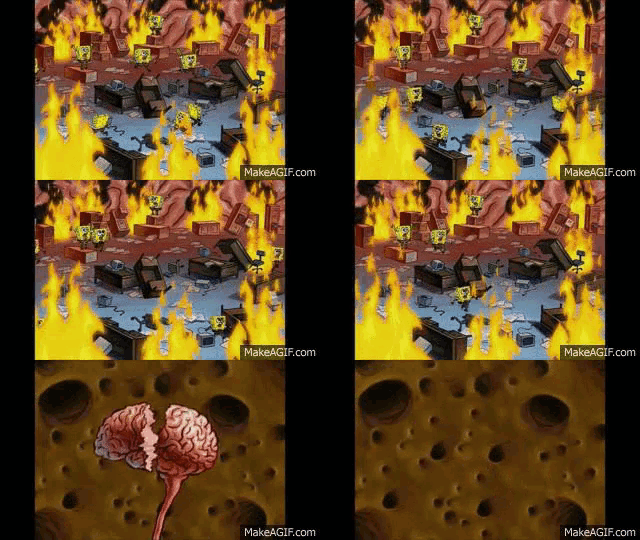
That distinction matters because the intensity of the feeling tells us surprisingly little about whether the trade itself has changed. A gambler watching the final possession of a tied game does not gain additional control by feeling every second more intensely, and neither does a trader simply because price is now ten ticks closer to the stop. The external expression may be quieter, but the underlying swing between relief, fear, hope, and anticipated loss can be remarkably similar.
The useful distinction is between informational and non-informational pain. Informational pain comes with evidence: structure fails, behavior contradicts the thesis, or the auction does something the original idea said it should not do. The discomfort is accompanied by information that matters.
Non-informational pain arrives without that evidence. Open profit feels too valuable to risk, temporary heat feels intolerable, or a missed move creates an urge to participate in the next one regardless of quality. Nothing meaningful has changed in the market, but something has changed in us.
This is not an argument for enduring pain blindly, since holding through invalidation because good traders tolerate discomfort is simply poor risk management wearing better vocabulary. The skill is narrower than that. Can I remain exposed when the market still supports the trade, even though my body would prefer the uncertainty to end, and can I exit when the information changes, even if remaining involved would feel better?
A large part of mature discretionary trading is learning not to solve an internal problem with a market action. The market gets the deciding vote.
Part 6: Build for the pendulum, not for perfect balance
If the operator changes under risk, discipline cannot depend entirely on that operator diagnosing himself correctly in real time, so important decisions have to move upstream. Consider a trader who takes two consecutive losses. Without a predefined rule, the next conversation happens inside his own head. Were the losses legitimate? Am I frustrated? Is the next setup good enough? Do I need a break, or am I using caution as an excuse to avoid the next trade? The same person who has just absorbed the losses is now responsible for deciding how much they affected him.
A mandatory reset removes that negotiation, because the rule was created earlier, by a version of the trader who was not trying to recover money, prove a thesis, or suppress frustration. After the second loss, he leaves the screen, and the market may produce another setup five minutes later, but that is irrelevant until the reset is complete. The point is not that two losses magically make somebody incapable of trading; the point is that the decision about whether to reset was made before the condition it governs existed.
The same logic applies to limiting repeated attempts on a single idea. A thesis may deserve a second execution, but at some point repeated attempts stop reflecting fresh information and begin reflecting attachment, and a predefined cap decides where that line sits before conviction has a chance to move it.
A defined trading window works similarly. When the primary opportunity period ends, continuing to stare at the screen is no longer the default, because the trader needs market evidence strong enough to justify departing from the structure, rather than boredom or anticipated reward quietly extending the session.
Pre-market readiness establishes the other side of the baseline. If I begin the morning underslept, distracted, physically depleted, or unusually activated, that information belongs inside the risk architecture before the first position is opened. It does not predict whether I will trade well, but it tells me something about the operator who is about to be exposed to uncertainty.
Post-session review then separates process from outcome once the immediate pressure has faded. A winning trade can contain behavior that should not be reinforced, and a losing trade can represent excellent execution, so without that separation, outcome becomes the teacher, and markets are inconsistent teachers.
Recovery belongs inside the same architecture. Sleep, exercise, nutrition, time away from the screen, and genuine psychological disengagement all influence the person who returns tomorrow, and during the session, even physically leaving the screen for a short period can interrupt the constant stream of unresolved information asking for our attention.
None of this requires turning trading into a collection of rituals. The purpose is simply to place discretion where it is most valuable: we want flexibility when new market information genuinely requires interpretation, and less flexibility when the primary variable changing is likely to be ourselves.
That changes what discipline means. Discipline is not holding some perfectly neutral internal state from the opening bell until the session ends. Winning will pull in one direction, losing will pull in another, and fatigue, boredom, uncertainty, and anticipated reward will keep applying force. The pendulum is going to move, and the work is deciding, before it moves too far, what happens when it does.
My background in physiology taught me to expect adaptation whenever a system is exposed to load, and markets made that lesson practical. So the question is no longer only, what is the market doing? It is also, what has this market already done to the person about to make the next decision? Build the process before that person needs it.